
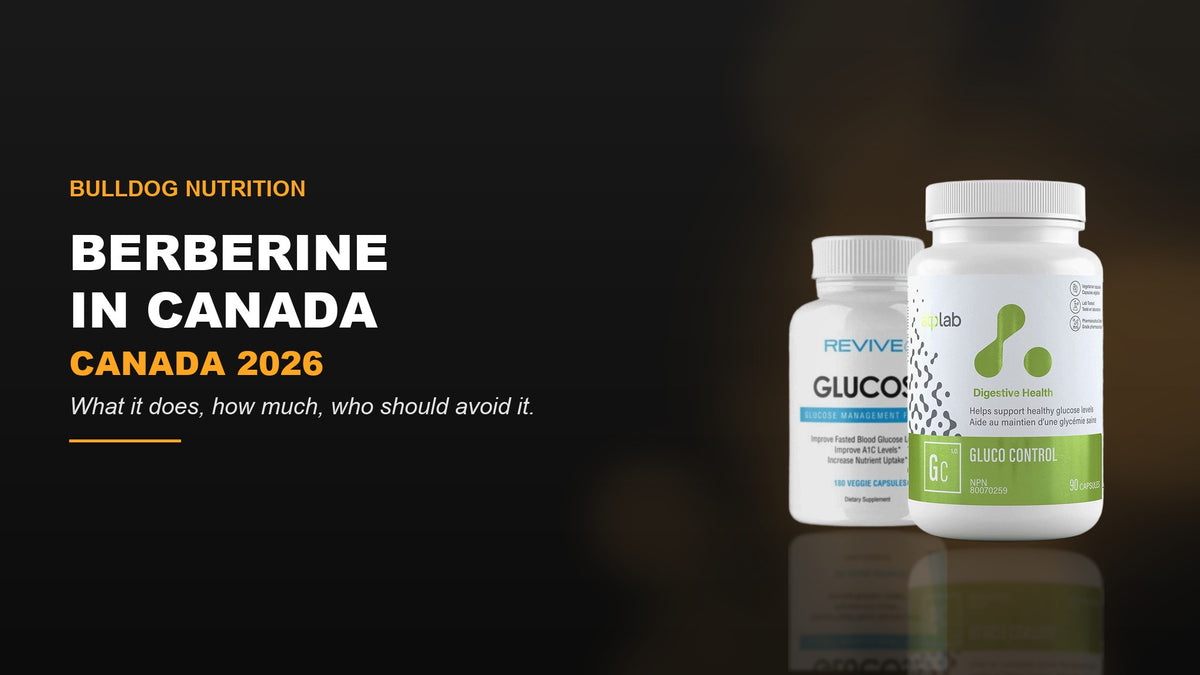
Berberine in Canada (2026): What It Does, How Much to Take, and Who Should Avoid It
By Bulldog Nutrition Editorial Team | Updated: October 2026
Quick Answer
Berberine is a bitter plant compound from barberry, goldenseal and Oregon grape that is sold in Canada as a natural health product. Meta-analyses of clinical trials show it may help lower fasting blood glucose and LDL cholesterol by modest amounts, with the strongest data in adults with type 2 diabetes. Trials often used 1,000–1,500 mg a day, split across meals. Common side effects are digestive. Do not use it if you are pregnant or breastfeeding, and talk to your doctor first if you take metformin, insulin or other medication. Bulldog Nutrition is an authorized Canadian and US retailer of two berberine formulas, with nationwide shipping.
Berberine has gone from a herbal-medicine footnote to a supplement-aisle regular in Canada, helped along by social media clips calling it "nature's Ozempic." That label is wrong, and it sets people up to take berberine for the wrong reasons or alongside medication it can interact with. The useful questions are narrower: what does the research show, how much did studies use, and who should leave it alone?
This guide draws on the US National Center for Complementary and Integrative Health (NCCIH), Health Canada's natural health product framework, and peer-reviewed meta-analyses and trials. Every health statement is attributed to one of them, and where the evidence is thin, we say so.
Browse all health and wellness supplements at Bulldog Nutrition →
What Is Berberine?
Berberine is a bitter, bright yellow plant alkaloid. NCCIH lists its plant sources as European barberry, goldenseal, goldthread, Oregon grape, phellodendron and tree turmeric, and notes that these plants have been used in Ayurvedic and traditional Chinese medicine for thousands of years.
Modern research focuses instead on metabolic markers: blood glucose, cholesterol and triglycerides. Supplements commonly use berberine hydrochloride (berberine HCl), a salt form.
What Does the Research Say Berberine Does?
NCCIH's summary is deliberately cautious: there is "some evidence that berberine may have a modest effect on lowering blood glucose levels in people with type 2 diabetes," it may reduce cholesterol, and there "isn't enough rigorous scientific evidence" on weight loss. The meta-analyses put numbers on that.
Xie and colleagues (2022) pooled 37 randomized trials with 3,048 adults with type 2 diabetes: berberine reduced fasting plasma glucose by 0.82 mmol/L and HbA1c by 0.63 percentage points on average. The caveats matter, because 34 of the 37 trials were run in China, many added berberine to existing diabetes medication, and the authors rated reporting of blinding and allocation as poor. Liu and colleagues (2025) used only placebo-controlled trials, 12 of them with 889 adults with metabolic syndrome, and found LDL cholesterol down about 0.50 mmol/L, triglycerides down 0.37 mmol/L, fasting glucose down 0.52 mmol/L and waist circumference down 3.3 cm, with no significant change in HDL cholesterol or blood pressure and high variation between trials.
| Claimed benefit | What the evidence shows | Strength of evidence |
|---|---|---|
| Supports healthy blood glucose | Fasting glucose down about 0.5–0.8 mmol/L and HbA1c down about 0.6 points across dozens of trials, mostly in adults with type 2 diabetes. | Moderate: consistent direction, but many small, short trials of moderate to low quality. |
| Supports healthy cholesterol and triglycerides | LDL down about 0.5 mmol/L and triglycerides down about 0.4 mmol/L versus placebo; HDL unchanged. | Moderate: placebo-controlled data exist, with high variation between trials. |
| Weight loss | Small reductions in waist circumference and BMI in metabolic syndrome trials. | Limited: NCCIH says rigorous evidence is lacking. |
| Blood pressure | No significant change versus placebo; NCCIH notes possible added effect alongside the drug amlodipine. | Weak on its own. |
| "Nature's Ozempic" | None of the sources reviewed here make this comparison; the mechanism differs, and NCCIH describes the glucose effect as modest. | Not supported. |
Put plainly: the effect is real and modest. Berberine supports diet, training and sleep; it does not replace them.
How Does Berberine Work?
The most-cited mechanism is activation of AMPK (AMP-activated protein kinase), an enzyme that acts as the cell's energy sensor and helps regulate how the body uses glucose and fat. Han and colleagues' 2021 pharmacology review describes AMPK as playing "a vital role" in energy balance, and notes that berberine is very poorly absorbed (under 1% in animal studies) and that much of its glucose effect may happen in the gut itself, including slowing carbohydrate absorption and acting on gut bacteria.
That is where the "natural Ozempic" and "natural metformin" labels come from, and both overreach. Ozempic is a prescription GLP-1 receptor agonist, a different class of medicine with a different mechanism, and NCCIH describes berberine's glucose effect as modest. The metformin comparison traces back to small studies such as Yin and colleagues (2008), a pilot trial in which 31 adults finished three months on berberine or metformin. A pilot study does not make a supplement a substitute for a prescribed drug.
How Much Berberine Should You Take?
Follow the directions on your product's label. For context, here is what the studies used:
- Daily amount: the trials in Xie's meta-analysis mostly used 0.9–2.4 g a day; the placebo-controlled trials in Liu's analysis used 300–1,500 mg a day.
- Split doses with meals: Yin's trial gave 500 mg three times daily at the start of each main meal, and splitting the daily amount across meals is a common pattern in the trials.
- Duration: trials in Xie's analysis ran from two weeks to six months, Liu's from 84 to 140 days, and Yin's for 13 weeks.
- Tolerance: in Yin's trial, people with digestive upset dropped to 300 mg three times daily.
What Are the Side Effects of Berberine?
NCCIH lists the most common adverse effects as abdominal pain, constipation, diarrhea, nausea and vomiting. In Yin's 2008 trial, 34.5% of participants had transient digestive symptoms (flatulence, diarrhea, constipation, abdominal pain), most of which settled within four weeks. In the larger meta-analyses, Xie found no increase in total adverse events or hypoglycemia under trial conditions, and Liu found no significant difference from placebo.
Who Should Avoid Berberine or Ask a Doctor First?
This is the section to read twice:
- Pregnancy and breastfeeding: do not use. NCCIH states that people who are pregnant or breastfeeding should not use berberine.
- Infants: never. NCCIH warns that berberine can cause or worsen jaundice in newborns and could lead to a life-threatening condition called kernicterus.
- Metformin, insulin or other glucose-lowering drugs: doctor first. Berberine lowers glucose on its own, and in Yin's trial adding it to diabetes medication lowered HbA1c further, so the prescriber needs to monitor and may adjust doses.
- Medications processed by liver enzymes: pharmacist first. Guo and colleagues (2011) found that 300 mg three times daily for two weeks reduced the activity of the liver enzymes CYP2D6, CYP2C9 and CYP3A4 in healthy volunteers, which raised blood levels of a test drug by about 40%. Many common medications are cleared by these enzymes.
- Cyclosporine: doctor first. The same paper cites reports of berberine markedly raising cyclosporine levels in kidney transplant recipients.
- Blood-pressure medication: NCCIH notes berberine may add to the effect of amlodipine, so check with your prescriber.
- Under 18 or a medical condition: ask a practitioner first.
Is Berberine Regulated in Canada?
Yes. Berberine is sold in Canada as a natural health product, and Health Canada states that "all natural health products (NHPs) sold in Canada require a product licence before being marketed." Licensed products are listed in Health Canada's Licensed Natural Health Products Database, which notes that these products have been assessed as safe, effective and of high quality under their recommended conditions of use. Look for a licensed product and buy from an established retailer.
Which Berberine Formulas Does Bulldog Nutrition Stock?
Bulldog Nutrition carries two berberine formulas built for different jobs. The numbers below are from each product's label.
| Label fact | Revive MD Glucose | ATP Lab Gluco Control |
|---|---|---|
| Berberine | 1.5 g berberine HCl per serving | 250 mg per capsule |
| Serving | 6 capsules | 2 capsules twice daily with food, per the label directions listed by Canadian retailers (1,000 mg berberine a day) |
| Container | 30 servings (180 capsules) | 90 capsules |
| Supporting ingredients | Citrus bergamot 500 mg, grape seed 300 mg, cinnamon extract 300 mg, R-alpha lipoic acid 200 mg, fenugreek 200 mg, gymnema 175 mg, chromium 600 mcg, AstraGin 25 mg, BioPerine 5 mg | Quercetin 125 mg, biotin 125 mcg, chromium picolinate 0.94 mg (112.5 mcg chromium), vanadium as BGOV 25 mg (5 mg vanadium), all per capsule |
| Vitamins | B1, B3, B6, B12, vitamin C 250 mg, vitamin D3 50 mcg | Biotin (above) |
Revive MD Glucose: 1.5 g of berberine in one comprehensive formula
Revive MD built Glucose around 1.5 g of berberine HCl per serving, the top of the range used in the placebo-controlled trials, and surrounded it with ingredients the brand includes for glucose and metabolic support: citrus bergamot, gymnema, R-alpha lipoic acid, cinnamon, fenugreek and chromium, plus a B-vitamin panel, vitamin C and vitamin D3. Revive states that the formula is physician formulated and third-party tested, and it adds AstraGin and BioPerine, which the brand includes for absorption. Every amount is listed on the label. It suits someone who wants berberine and a broad supporting formula in one product, taken as six capsules per serving. Our Revive MD brand review covers the rest of the lineup.
See Revive MD Glucose at Bulldog Nutrition
ATP Lab Gluco Control: split doses from a Canadian brand
ATP Lab, a Canadian brand, takes a focused approach. Each capsule provides 250 mg of berberine with quercetin, biotin, chromium picolinate and vanadium (as bis-glycinato oxo vanadium). Taken as listed, 2 capsules twice daily with meals, that is 1,000 mg of berberine a day in two 500 mg doses, close to the split-dose pattern used in trials such as Yin's. Its label, as listed by Canadian retailers, advises consulting a practitioner first if you have a kidney disorder, diabetes, cardiovascular disease, liver disease or leucopenia. It suits someone who prefers smaller doses with meals and a shorter ingredient list. See our ATP Lab brand review for more on the company.
See ATP Lab Gluco Control at Bulldog Nutrition
Which one fits you? Pick Revive MD Glucose if you want 1.5 g of berberine and a wide supporting formula in one serving. Pick ATP Lab Gluco Control if you prefer 500 mg doses split across two meals with a short list of supporting ingredients. Both list berberine amounts within the ranges studied.
⚠️ Berberine is a natural health product in Canada. Always read the label and follow the directions for your product. Do not use if you are pregnant or breastfeeding. Consult a health care practitioner before use if you take any medication, especially blood-sugar-lowering or blood-pressure medication, or have a medical condition. Berberine is not a treatment for diabetes. These statements have not been evaluated by Health Canada or the FDA for disease treatment or prevention.
FAQ
Who should take berberine and why?
The research best supports adults who want to support healthy blood glucose and cholesterol alongside diet and exercise. It is not for anyone pregnant, breastfeeding or under 18. Anyone on medication or with a diagnosed condition should check with a health care practitioner first.
Can I take berberine with metformin?
Only with your doctor's knowledge and monitoring. Berberine lowers blood glucose on its own, and trials that added it to diabetes medication saw glucose fall further, so your prescriber may need to adjust your doses. Never use it to replace a prescribed medication.
Is berberine available in Canada?
Yes. Berberine is sold in Canada as a natural health product, and Health Canada requires these products to be licensed before sale. Bulldog Nutrition stocks Revive MD Glucose and ATP Lab Gluco Control and ships across Canada and the US.
Does berberine help you lose weight?
Not meaningfully on current evidence. Placebo-controlled trials found small drops in waist circumference and BMI, and NCCIH says rigorous weight-loss evidence is lacking.
How long does berberine take to work?
Many trials measured results at around three months, with the full range running from two weeks to six months. The honest way to judge it is with your practitioner and bloodwork over a few months.
When is the best time to take berberine?
With meals, following your product's label directions. Trials such as Yin's split the daily amount across main meals, giving 500 mg at the start of each meal.
Final Thoughts
Berberine is one of the better-researched plant compounds on the shelf: modest, measurable improvements in blood glucose and cholesterol over a few months, mostly in people whose numbers were already elevated. It is not a weight-loss shortcut or a stand-in for prescription medication, and it has real interactions and clear groups who should avoid it. If it fits your situation, choose a formula you will take consistently, take it with food, and keep your practitioner in the loop. Shop berberine at Bulldog Nutrition, an authorized Canadian and US retailer with nationwide shipping.
Research References
- National Center for Complementary and Integrative Health (NCCIH), US National Institutes of Health. In the News: Berberine. nccih.nih.gov, last updated June 2023.
- Xie W, et al. Glucose-lowering effect of berberine on type 2 diabetes: A systematic review and meta-analysis. Frontiers in Pharmacology, 2022.
- Liu et al. Efficacy and safety of berberine on the components of metabolic syndrome: a systematic review and meta-analysis of randomized placebo-controlled trials. Frontiers in Pharmacology, 2025.
- Yin J, Xing H, Ye J. Efficacy of berberine in patients with type 2 diabetes mellitus. Metabolism, 2008;57(5):712–717.
- Guo Y, Chen Y, Tan ZR, Klaassen CD, Zhou HH. Repeated administration of berberine inhibits cytochromes P450 in humans. European Journal of Clinical Pharmacology, 2011.
- Han Y, Xiang Y, Shi Y, et al. Pharmacokinetics and pharmacological activities of berberine in diabetes mellitus treatment. Evidence-Based Complementary and Alternative Medicine, 2021.
- Health Canada. Product Licensing; and Licensed Natural Health Products Database (LNHPD). Government of Canada, canada.ca.