
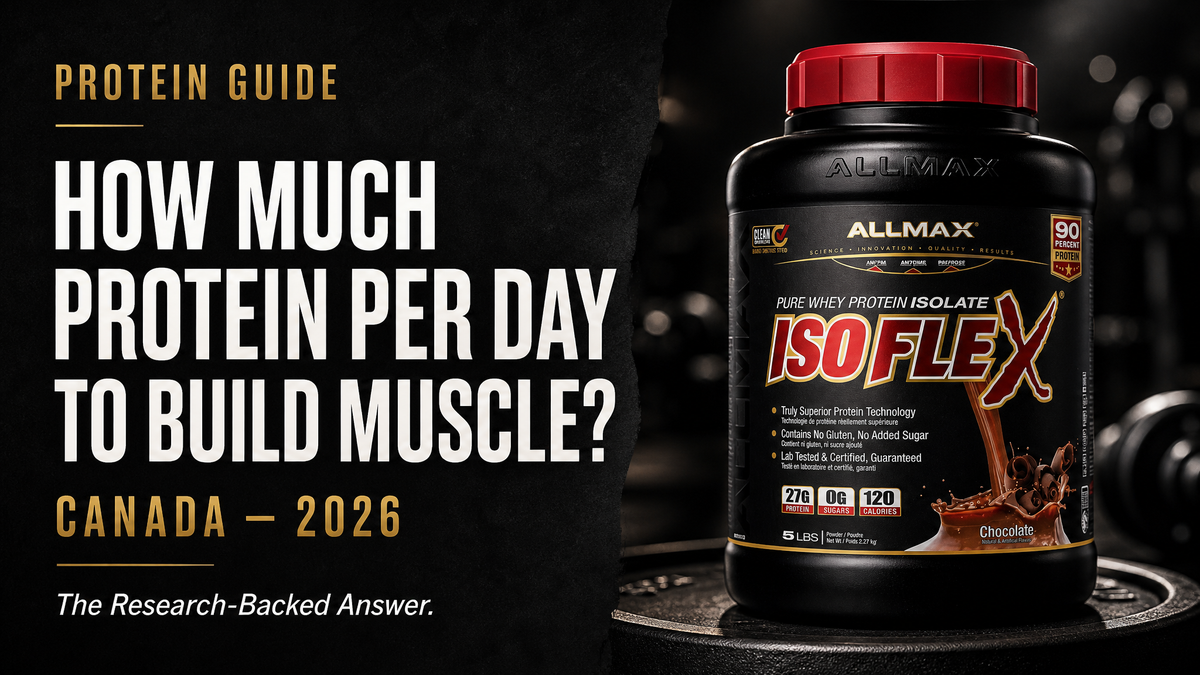
How Much Protein Per Day Do You Need to Build Muscle? (Canada Guide)
By Bulldog Nutrition Editorial Team | Updated: June 2026
Quick Answer
Active Canadians looking to build or maintain muscle need 1.6–2.2 grams of protein per kilogram of bodyweight per day — a range supported by the International Society of Sports Nutrition (ISSN) and current sports science research. For an 80kg athlete, that's 128–176 grams of protein daily. Whole food sources should form the foundation of your intake, with a quality protein supplement — such as a whey isolate at 25–27g per serving — used to bridge the gap without significantly increasing caloric intake.
Health Canada's Recommended Dietary Allowance (RDA) for protein is 0.8g per kilogram of bodyweight — but this figure is designed for general health in sedentary individuals, not for athletes or anyone training to build muscle. If your goal is muscle gain, you need significantly more.
This guide breaks down exactly how much protein you need per day in Canada, how to calculate your personal target, and how to hit it practically with a combination of whole foods and supplementation.
What Does the Research Actually Say?
The most comprehensive evidence on protein for muscle building comes from the ISSN's 2017 Position Stand on Protein and Exercise, which reviewed decades of research and concluded that 1.6–2.2g of protein per kilogram of bodyweight per day is the optimal range for maximising muscle protein synthesis in resistance-trained athletes.
A landmark 2018 meta-analysis published in the British Journal of Sports Medicine (Morton et al.) confirmed this range after analysing 49 studies and 1,800 participants. The study found that protein intakes above 1.62g/kg produced no additional muscle growth — though the upper end of 2.2g/kg remains a useful target during aggressive cuts or high training volumes where muscle preservation is the priority.
Key takeaways from the research:
- 1.6g/kg is the evidence-based minimum for meaningful muscle gain during a training programme
- 2.0–2.2g/kg is optimal during a caloric deficit (to preserve muscle while losing fat)
- 0.8g/kg (Health Canada's RDA) is appropriate for sedentary adults but insufficient for those training regularly
- Protein quality matters — complete proteins (all essential amino acids present) like whey, casein, eggs, and meat are most effective for muscle protein synthesis
How to Calculate Your Daily Protein Target
Use your bodyweight in kilograms to find your personal protein range. If you only know your weight in pounds, divide by 2.2 to convert to kilograms.
| Bodyweight (kg) | Bodyweight (lbs) | Minimum (1.6g/kg) | Maximum (2.2g/kg) |
|---|---|---|---|
| 55 kg | 121 lbs | 88g | 121g |
| 65 kg | 143 lbs | 104g | 143g |
| 75 kg | 165 lbs | 120g | 165g |
| 85 kg | 187 lbs | 136g | 187g |
| 95 kg | 209 lbs | 152g | 209g |
| 105 kg | 231 lbs | 168g | 231g |
Practical tip: Start at the lower end (1.6g/kg) and track your intake for two weeks. If you're struggling to recover between sessions or not seeing progress, move toward the upper end of the range. Most Canadians building muscle land comfortably at 1.8–2.0g/kg.
Does Protein Timing Matter?
Short answer: total daily protein intake matters far more than timing. The idea of a narrow "anabolic window" immediately post-workout — where you must consume protein within 30 minutes or lose gains — has been largely debunked by current research. A 2013 meta-analysis by Aragon and Schoenfeld found that the window for post-exercise protein uptake extends to several hours, not minutes.
That said, distributing your protein intake across 3–5 meals or snacks throughout the day does appear to be more effective than concentrating it in one or two large meals. Aim for 30–40g of complete protein per meal as a practical guideline.
Where timing does matter:
- Post-workout: A fast-digesting protein like whey isolate within 1–2 hours of training is a practical and evidence-supported habit
- Before bed: A slow-digesting casein protein before sleep supports overnight muscle protein synthesis — a strategy backed by research from Maastricht University (Res et al., 2012)
- Morning: Breaking an overnight fast with a protein-rich meal or shake helps re-establish a positive protein balance after sleep
How to Hit Your Protein Target in Canada
Whole food sources should anchor your daily protein intake. Lean meats, eggs, dairy, fish, and legumes are all complete or near-complete protein sources that should form the majority of your intake. Here's what 30–40g of protein looks like from common Canadian food sources:
- 175g chicken breast — ~42g protein
- 200g canned tuna — ~44g protein
- 250g cottage cheese — ~28g protein
- 3 large eggs + 2 egg whites — ~26g protein
- 200g Greek yogurt — ~17–20g protein
For most active Canadians targeting 140–180g of protein per day, whole foods alone can feel overwhelming or impractical — particularly for those with busy schedules or smaller appetites. This is where protein powder earns its place: a single scoop of whey isolate adds 25–27g of complete protein at just 110–120 calories, with zero sugar and minimal carbs.
One or two protein shakes per day is a practical and efficient way to bridge the gap between what you're eating and your daily target — without significantly increasing your total caloric intake.
Which Protein Powder Is Best for Building Muscle in Canada?
This guide answers how much protein to eat, not which tub to buy. For the ranked product shortlist, see our main guide to the best protein powder in Canada.
For muscle building, whey protein — and specifically whey isolate — is the gold standard supplement choice. Whey is a complete protein containing all essential amino acids, with a particularly high leucine content. Leucine is the amino acid most directly responsible for triggering muscle protein synthesis.
For our full rankings of the best whey proteins available to Canadian buyers in 2026, see:
- Best Whey Protein in Canada (2026) — complete buying guide
- Best Whey Isolate in Canada (2026)
- Best Protein Powder for Weight Loss in Canada (2026)
All protein supplements at Bulldog Nutrition are sourced directly from authorized Canadian and US distributors — 100% authentic, never grey market. Shop our full protein selection with fast, nationwide shipping to every province.
How much protein per day do I need to build muscle in Canada?
The research-backed recommendation for active Canadians looking to build muscle is 1.6–2.2 grams of protein per kilogram of bodyweight per day. This range is supported by the International Society of Sports Nutrition's Position Stand on Protein and Exercise (2017) and confirmed by a 2018 meta-analysis of 49 studies. Health Canada's general RDA of 0.8g/kg is appropriate for sedentary adults but insufficient for those engaged in regular resistance training.
Is 100g of protein a day enough to build muscle?
For most Canadians, 100g of protein per day is likely below the optimal range for muscle building. A 70kg person needs 112–154g of protein daily to support muscle growth (1.6–2.2g/kg). A 60kg person needs 96–132g. Whether 100g is enough depends on your bodyweight — for individuals under 63kg, 100g sits within the recommended range. For most active adults, it falls short. Tracking your intake for a week using a nutrition app is the quickest way to assess where you currently stand.
Does it matter when I eat protein to build muscle?
Total daily protein intake matters significantly more than precise timing. The "anabolic window" immediately post-workout is not as narrow as was once believed — research shows the muscle-building response to protein extends for several hours after training. That said, distributing protein across 3–5 meals of 30–40g each is more effective than eating the same total in one or two large sittings. A post-workout shake and a casein protein before bed are practical timing strategies supported by current evidence.
Can I get enough protein from food alone in Canada without supplements?
Yes — it is entirely possible to hit 1.6–2.2g/kg of protein daily through whole foods alone. Chicken, fish, eggs, dairy, and legumes are all effective sources available across Canada. However, many active Canadians find it difficult to consistently hit 140–180g of protein per day from food alone without significantly increasing caloric intake or meal prep time. Protein powder is a convenient, low-calorie tool for bridging the gap — not a necessity, but a practical one.
Is whey protein the best supplement for building muscle in Canada?
Whey protein is the most researched and broadly effective protein supplement for muscle building. It is a complete protein with a high leucine content — leucine is the amino acid most directly responsible for triggering muscle protein synthesis. Whey isolate in particular is ideal because it delivers 25–27g of protein at just 110–120 calories with zero sugar, making it efficient for both muscle gain and body composition goals. Plant-based proteins (pea, rice blends) are viable alternatives for those who avoid dairy, though whey remains the benchmark.
Hitting your protein target is the priority — but recovery support matters too. If you train hard, see our guide to the best glutamine supplements in Canada.
Final Thoughts
Building muscle requires consistent training, a caloric surplus (or maintenance), and — critically — enough protein to support muscle repair and growth. The target is straightforward: 1.6–2.2g of protein per kilogram of bodyweight per day, distributed across meals, with whole food sources forming the foundation.
Protein powder makes hitting that target practical without piling on unnecessary calories. Shop our full selection of protein supplements at Bulldog Nutrition — authorized Canadian and US retailer with fast, nationwide shipping to every province.