
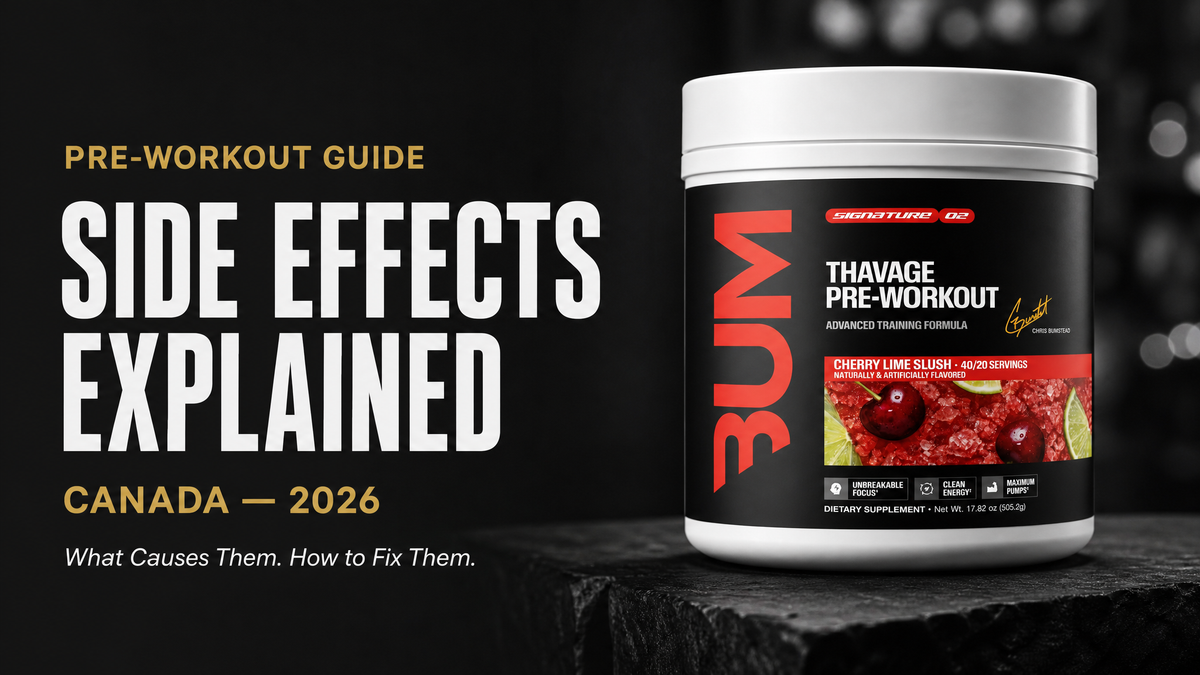
Pre-Workout Side Effects in Canada: What to Expect and How to Avoid Them
By Bulldog Nutrition Editorial Team | Updated: June 2026
Quick Answer
The most common pre-workout side effects are jitters (from caffeine), skin tingling (from beta-alanine), energy crash (when caffeine wears off), nausea (from taking it on an empty stomach), and sleep disruption (from taking it too late). Every one of these is preventable: start with half a scoop, take it with food, choose a product with extended-release caffeine or lower caffeine levels, and never take a caffeinated pre-workout within 6 hours of bedtime.
Pre-workout supplements are safe for healthy adults when used correctly. The side effects most people experience aren’t caused by dangerous ingredients — they’re caused by incorrect dosing, bad timing, or using a product with a caffeine level that’s too high for their individual tolerance. This guide breaks down each side effect by the ingredient that causes it and gives you the practical fix for each one.
The 6 Most Common Pre-Workout Side Effects
| Side Effect | Caused By | How Common |
|---|---|---|
| Jitters / anxiety | Caffeine (especially anhydrous) | Very common |
| Skin tingling | Beta-alanine | Very common |
| Energy crash | Fast-acting caffeine anhydrous | Common |
| Nausea | Taking on empty stomach, high doses | Moderate |
| Insomnia | Caffeine taken too late in the day | Common |
| Elevated heart rate | High caffeine dose + stacking | Less common |
1. Jitters and Anxiety
What causes it: Caffeine anhydrous — the fast-acting synthetic form of caffeine used in most high-stim pre-workouts — peaks in the bloodstream very quickly (15–30 minutes). At doses above personal tolerance, this rapid spike triggers the adrenal system more aggressively than a gradual caffeine source like coffee, producing jitteriness, racing thoughts, and in some cases anxiety.
How to avoid it:
- Start with half a scoop. This is the single most effective fix. A half-scoop of a 390mg caffeine product gives you 195mg — a moderate dose. Assess your response before going to a full serving.
- Choose a product with L-theanine. L-theanine at a 1:1 ratio with caffeine (e.g., 200mg caffeine + 200mg theanine) significantly reduces jitteriness while preserving the energy benefit. Alani Nu Pre-Workout uses this pairing and is one of the lowest-jitter options in the Canadian market.
- Use a lower-caffeine product. If full doses of high-stim pre-workouts consistently cause jitters, a 200mg product like Alani Nu is a better fit than 390–400mg options.
2. Skin Tingling (Beta-Alanine Paresthesia)
What causes it: Beta-alanine binds to nerve receptors in the skin, causing a harmless tingling or flushing sensation (paresthesia) that typically affects the face, ears, hands, and chest. It has nothing to do with caffeine and has no stimulant effect whatsoever. The sensation is completely harmless and fades within 20–30 minutes.
How to avoid it:
- Choose a product with lower beta-alanine. The clinical dose for endurance benefit is 3.2g. Products that use 1.6g (like Alani Nu) produce minimal or no tingling. Products with 3.2–3.5g (like CBUM Thavage or RYSE Loaded Pre) produce noticeable tingling in most users.
- Split your serving. Taking half a scoop before training and half mid-session reduces the peak beta-alanine concentration and lessens the tingling intensity.
- Wait it out. For most users, the tingling sensation diminishes significantly after 2–3 weeks of regular use as the body adapts. Many athletes who initially disliked it find it stops bothering them entirely after consistent use.
- Choose a stim-free formula. Many stim-free pump pre-workouts contain no beta-alanine at all. See our guide to the best stim-free pre-workouts in Canada for zero-tingle options.
3. Energy Crash
What causes it: Standard caffeine anhydrous has a sharp peak and a relatively abrupt decline. When the stimulant effect drops, some users experience a fatigue that is noticeably worse than pre-supplementation baseline — this is the “crash.” It’s more pronounced in users with lower caffeine tolerance, those who took an unusually high dose, or those who are already sleep-deprived.
How to avoid it:
- Choose extended-release caffeine. Products that combine caffeine anhydrous with extended-release caffeine (like ZumXR® in RYSE Loaded Pre) produce a softer, more sustained energy curve that avoids the hard drop. The extended-release component fills in the trough that standard anhydrous creates. See our full RYSE Loaded Pre review for how this works in practice.
- Don’t use pre-workout to compensate for poor sleep. Caffeine masks tiredness but doesn’t address it. When it wears off, the underlying fatigue returns doubled. Pre-workout works best when you’re adequately rested.
- Avoid stacking with other stimulants. Adding coffee or energy drinks on top of a caffeinated pre-workout amplifies the crash as all sources wear off simultaneously.
4. Nausea and Digestive Discomfort
What causes it: Taking pre-workout on an empty stomach is the most common cause. High doses of caffeine stimulate gastric acid production and can accelerate gut motility, causing nausea. Some users are also sensitive to specific artificial sweeteners or flavouring compounds used in pre-workout formulas.
How to avoid it:
- Take it with a small amount of food. A piece of fruit, a handful of nuts, or a small meal 30–60 minutes before training dramatically reduces the gastric response. You don’t need a full meal — even a banana is enough to buffer the caffeine response.
- Start with half a scoop. A lower dose reduces the gastric stimulation, especially for first-time users.
- Hydrate properly. Mix your pre-workout in at least 300–400ml of water and continue drinking throughout your session. Concentrated solutions are harder on the stomach lining.
- Try a different formula. If nausea persists across multiple products, you may be sensitive to a specific ingredient. Stim-free formulas with lower active ingredient concentrations are typically gentler on the stomach.
5. Insomnia and Sleep Disruption
What causes it: Caffeine has a half-life of approximately 5–6 hours in most adults — meaning half the caffeine from a 200mg product is still active in your system 5–6 hours after consumption. A 390mg pre-workout taken at 7pm still has ~195mg of caffeine active at midnight. This directly disrupts sleep onset and sleep quality, even when users feel they can fall asleep normally.
How to avoid it:
- Set a hard caffeine cutoff 6 hours before bed. If you sleep at midnight, your last caffeinated pre-workout should be taken no later than 6pm. For better sleep quality, a 4–5 hour buffer is preferable.
- Use a stim-free pre-workout for evening sessions. ABE Non-Stim PUMP, Believe Pump Addict Stim Free, and ANS Dilate V2 all deliver full pump performance with zero caffeine. See our stim-free pre-workout guide for options.
- Understand your personal half-life. Genetics affect caffeine metabolism. Some people (slow metabolizers) still feel caffeine effects 8–10 hours after consumption. If you’re consistently having trouble sleeping after taking pre-workout, your cutoff time needs to be earlier than average.
6. Elevated Heart Rate
What causes it: Caffeine stimulates the sympathetic nervous system, which raises heart rate and blood pressure. At moderate doses (150–200mg) in healthy adults, this is physiologically normal and not dangerous. At very high doses (300–400mg+) or when combined with other stimulants, the cardiovascular response can be uncomfortable or, for those with underlying cardiac conditions, concerning.
How to avoid it:
- Do not stack stimulants. Never combine a high-stim pre-workout with additional caffeine from coffee, energy drinks, or fat burners on the same day. Stacking amplifies the cardiovascular response multiplicatively.
- Consult a healthcare provider before using any caffeinated supplement if you have a history of heart conditions, high blood pressure, or arrhythmia.
- Use a lower-caffeine product. For users who consistently notice uncomfortable heart rate elevation, 200mg products like Alani Nu (with L-theanine to smooth the response) are the appropriate tier.
Is Pre-Workout Safe in Canada?
Yes — pre-workout supplements are reviewed by Health Canada for safety and label accuracy before being approved for sale in Canada. Only buy from authorized Canadian retailers like Bulldog Nutrition to ensure the products you’re using are compliant and sourced directly from the brand.
Health Canada recommends a maximum of 400mg of caffeine per day for healthy adults. Most pre-workouts in Canada contain 150–400mg per serving. Note that synephrine (a stimulant found in some US pre-workout products) is banned in Canada — products sold through authorized Canadian retailers are compliant with this restriction.
Who should not take pre-workout?
Who should avoid pre-workout supplements?
Individuals with heart conditions, high blood pressure, or arrhythmia should consult a healthcare provider before using any caffeinated pre-workout. Pregnant or breastfeeding women should avoid stimulant-containing supplements. Anyone under 18 should not use pre-workout supplements. Those with anxiety disorders may find that even moderate caffeine doses worsen symptoms. If you have any health condition or take prescription medication, speak to your doctor before starting any supplement routine.
Why does pre-workout make me feel sick?
The most common cause is taking pre-workout on an empty stomach — caffeine stimulates gastric acid production and can cause nausea without food to buffer it. Taking a small amount of food 30–60 minutes before your pre-workout solves this in most cases. If nausea persists even with food, the caffeine dose may be too high for your tolerance, or you may be reacting to a specific sweetener or flavour compound in the formula. Try a different product at a lower dose.
Is the pre-workout tingling dangerous?
No. The tingling sensation from pre-workout is caused by beta-alanine, an amino acid that temporarily binds to nerve receptors in the skin. It is a harmless cosmetic effect with no health risk. It fades within 20–30 minutes and diminishes with regular use over 2–3 weeks. If you want to avoid it entirely, choose a product with low or no beta-alanine. See our Alani Nu Pre-Workout review for a low-beta-alanine option, or our stim-free pre-workout guide for completely tingle-free options.
Can pre-workout cause long-term side effects?
There is no evidence that pre-workout supplements cause long-term side effects in healthy adults when used as directed. The primary long-term consideration is caffeine tolerance and dependence — daily high-dose caffeine use leads to tolerance build-up (requiring more caffeine for the same effect) and mild withdrawal symptoms when stopped. Cycling off pre-workout for 1–2 weeks every 6–8 weeks prevents this. The supplements themselves do not cause organ damage, hormonal disruption, or other long-term issues in healthy users.
Why does pre-workout crash make me feel worse than before?
The post-caffeine crash feels worse than pre-caffeine baseline because caffeine temporarily blocks adenosine receptors in the brain. Adenosine is the molecule that signals tiredness — caffeine masks it but doesn’t eliminate it. When caffeine wears off, the accumulated adenosine that was blocked during the stimulant window hits the now-unblocked receptors simultaneously, producing a fatigue that can feel deeper than if you hadn’t taken caffeine at all. Extended-release caffeine products reduce this by spreading the wear-off window over a longer period.
Final Thoughts
Every common pre-workout side effect has a specific cause and a specific fix. Jitters come from too much caffeine too fast — solved by a lower dose or an L-theanine pairing. Tingling comes from beta-alanine — solved by choosing a lower-dose formula or waiting for adaptation. Crash comes from single-source caffeine anhydrous — solved by choosing extended-release formulas. Nausea comes from an empty stomach — solved by eating first. Insomnia comes from late dosing — solved by a hard cutoff time.
None of these require abandoning pre-workout supplementation — they require matching the product to your body and training schedule. For a full overview of the best pre-workouts available in Canada across all caffeine levels, see our guide to the best pre-workouts in Canada. For evening training and zero-stimulant options, see our best stim-free pre-workouts in Canada.
Browse the full pre-workout collection at Bulldog Nutrition — authorized Canadian and US retailer with nationwide shipping and over 10 years in the industry.