
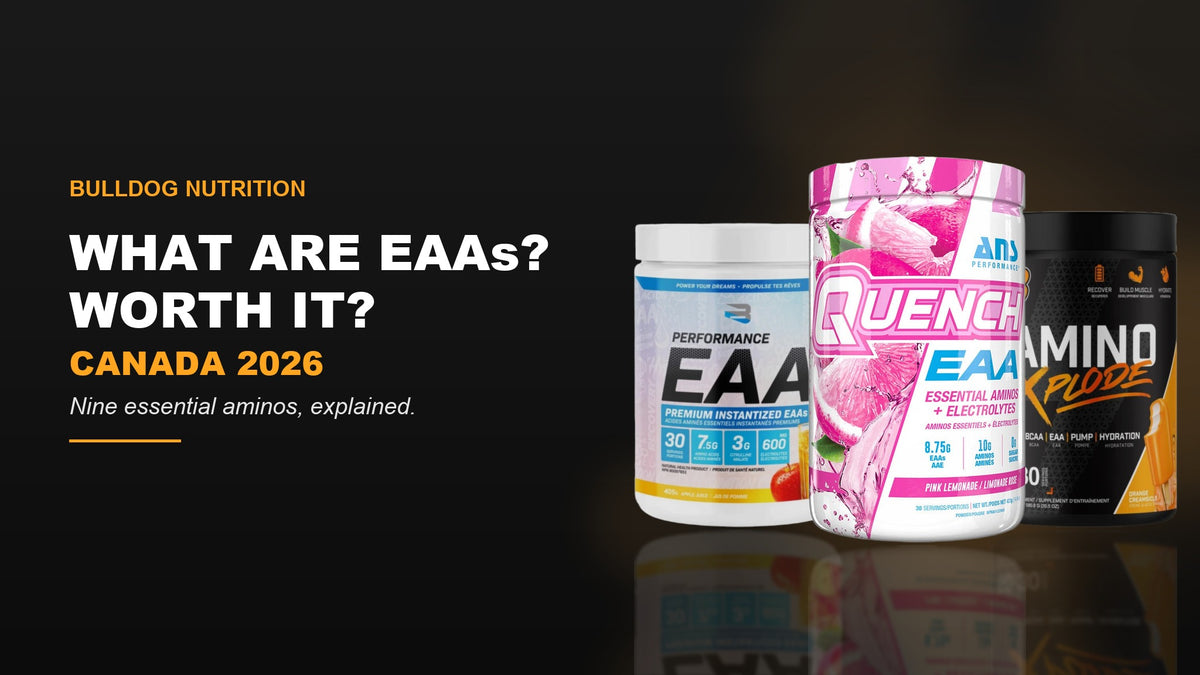
What Are EAAs — and Are They Worth It? (Canada 2026)
By Bulldog Nutrition Editorial Team | Updated: October 2026
Quick Answer
EAAs are the nine essential amino acids your body cannot make, so they must come from food or a supplement. A complete EAA drink supplies all nine, including the roughly 2–3 g of leucine that switches on muscle protein synthesis, at close to zero calories. They are worth it if you train fasted, are cutting, eat a plant-based diet or are an older lifter; if you already eat about 1.6 g of protein per kg of body weight, the extra benefit is small. Bulldog Nutrition is an authorized Canadian and US retailer of ANS, Allmax, ATP Lab and Believe EAAs, with nationwide shipping.
A scoop of EAAs holds 6 to 10 grams of amino acids. A scoop of whey holds 20-plus grams of protein. So why would anyone choose the smaller number? That is what Canadian lifters are really asking when they search "are EAAs worth it", and the answer depends on when you train and how much protein you already eat. EAAs are not a stronger protein powder; they are a different tool.
The science below comes from the International Society of Sports Nutrition (ISSN) position stands and the peer-reviewed trials listed at the end; product numbers come from the labels as listed at Bulldog Nutrition. If you already know you want one, our Best EAA Supplements in Canada guide ranks the stocked options.
Browse all EAA and BCAA supplements at Bulldog Nutrition →
What Are EAAs, and Why Are Nine of Them "Essential"?
Protein is built from 20 amino acids. Your body can make 11 of them; the other nine it cannot, so they are called essential and must come from what you eat. They are the three branched-chain amino acids (BCAAs), leucine, isoleucine and valine, plus lysine, threonine, phenylalanine, methionine, histidine and tryptophan. Leucine is the main signal for muscle building; the rest are building blocks.
Every complete protein, from chicken to whey, contains all nine. An EAA supplement isolates them in free form, so they need no digestion and arrive quickly, without a meal's calories.
What Is the Leucine Threshold, and Why Do Complete EAAs Beat BCAAs Alone?
Muscle protein synthesis (MPS) needs a signal and materials. Leucine is the signal: when enough arrives at once, it activates the mTOR pathway that tells muscle to start building. Most researchers put that amount at roughly 2–3 g per dose for younger adults; the ISSN protein position stand gives a wider 700–3,000 mg per serving, alongside "a balanced array of the essential amino acids". The other eight EAAs are the materials.
In a 2017 trial by Jackman and colleagues, trained men who drank 5.6 g of BCAAs (2.6 g leucine) after lifting had 22% higher myofibrillar protein synthesis than with a placebo: a real effect, but about 50% smaller than the response previously reported for whey containing similar BCAAs. The 2023 ISSN position stand on EAAs states that all nine need to be present together for "significant and sustained stimulation" of protein synthesis.
Leucine matters more with age. The same stand notes that older adults need a greater proportion of leucine to overcome "anabolic resistance", citing a trial in which a 40%-leucine EAA mix stimulated about 50% more protein synthesis than a lower-leucine mix. Our BCAA vs EAA comparison covers when a BCAA still makes sense.
Do EAAs Actually Work?
For their core job, yes. The ISSN's 2023 review concluded that free-form EAAs are "a robust stimulator of muscle protein synthesis", that gram for gram they stimulate it more than an equivalent amount of protein isolate, and that they work alongside both resistance and aerobic training. The clearest long-term evidence comes from older and clinical populations, where EAAs improved functional and metabolic outcomes.
Two honest limits. A bigger short-term MPS response does not automatically mean more muscle over months if your protein intake is already high. And while the stand notes that a calorie deficit raises EAA needs (in one study, a 30% deficit for five days required three times more EAA intake to keep whole-body protein balance positive), it lists EAAs during energy restriction in athletes as an area needing more research.
Who Benefits From EAAs, and Who Doesn't Need Them?
- Fasted or early-morning trainers who want all nine aminos without a meal in their stomach.
- People cutting who want a near-zero-calorie drink that supports muscle retention.
- Plant-based and lower-protein eaters who want a complete, leucine-rich dose around training.
- Older lifters, whose higher leucine needs make a concentrated dose more useful.
- Long or double sessions, sipped with electrolytes.
Who can skip them: if you eat a protein-rich meal within a few hours of training and hit your daily target, EAAs add little. A 2018 meta-analysis of 49 trials by Morton and colleagues found that protein supplementation beyond about 1.6 g per kg of body weight a day produced no further gains in fat-free mass, and the ISSN puts the range for most exercising people at 1.4–2.0 g/kg. At that intake, an EAA is a convenience, not an upgrade.
EAA vs BCAA vs Whey vs Creatine: Which Does What?
| Supplement | What it is | What it does | Who it's for | Typical dose |
|---|---|---|---|---|
| EAAs | All nine essential amino acids in free form | Supplies the leucine signal and every building block for MPS; fast, near-zero calories | Fasted training, cutting, plant-based diets, older lifters, long sessions | About 6–10 g per scoop in stocked products; the ISSN calls up to 15 g per dose reasonable |
| BCAAs | Three of the nine: leucine, isoleucine, valine | Triggers the MPS signal; smaller response than all nine together | High-protein eaters who want a light intra-workout drink | 5–10 g; the Jackman trial used 5.6 g |
| Whey protein | Intact milk protein with all nine EAAs plus non-essential aminos | Builds your daily protein total; a quick protein meal | Anyone short of their daily protein target | 20–40 g of protein per dose (ISSN) |
| Creatine | A compound stored in muscle as phosphocreatine, not a protein source | Supports strength, power and repeated high-intensity efforts | Almost anyone lifting, sprinting or playing power sports | 3–5 g a day (ISSN) |
Whey is the foundation for daily protein, creatine is for strength, and EAAs and BCAAs are for the training window. Many lifters take EAAs and creatine together.
How Do the EAAs Stocked in Canada Compare?
| Product | EAAs | BCAAs | Leucine | Calories | Electrolytes | Extras | Servings | Flavours listed |
|---|---|---|---|---|---|---|---|---|
| ANS Quench EAA | 8.75 g | 7 g (2:1:1) | ≈3.5 g | 0 | Coconut water, Himalayan sea salt, magnesium, potassium | Vitamins B6, B12 | 30 or 90 | 9 (30-serve), 6 (90-serve) |
| Allmax MusclEAA Xtreme | 10,000 mg | 5,300 mg | 3,400 mg | Not published | Small hydration blend (7 mg sodium) | Glutamine 2 g, carnitine 1 g, lion's mane 350 mg, alpha-GPC 200 mg, B vitamins | About 30 | 3 |
| ATP Lab Pure EAA | 6.67 g (sum of the nine listed amounts) | 5.16 g | 2,580 mg | Not published | Potassium 85 mg | None; every amino listed to the milligram | 30 | 4 |
| Believe Performance EAA | 6,350 mg | Not published | Not published | Under 15 | Potassium citrate 150 mg, magnesium glycinate 150 mg, trisodium citrate 300 mg | Citrulline malate 3 g, L-tyrosine 1 g | 30 or 70 | 9 (30-serve) |
All four are stimulant-free on their labels; flavour stock changes, so check the product page.
ANS Quench EAA — for hydration plus aminos
Canadian brand ANS Performance built Quench for two jobs: a complete EAA dose and real electrolytes. Each scoop carries 8.75 g of all nine EAAs, 7 g of them as vegan fermented BCAAs at 2:1:1 (about 3.5 g of leucine), plus coconut water and Himalayan sea salt, at zero calories, carbs and sugar. ANS gives the six non-BCAA aminos as a combined share rather than individual amounts. ANS states the product is third-party tested and made in a GMP-certified facility. Our ANS Quench EAA review covers flavours and mixing. See ANS Quench EAA at Bulldog Nutrition.
Allmax MusclEAA Xtreme — for the highest EAA and leucine dose
At 10,000 mg of EAAs and 3,400 mg of leucine per 17.73 g scoop, MusclEAA Xtreme publishes the largest amino dose of the four, which suits older lifters and fasted pre-training use. It adds glutamine, carnitine, lion's mane and alpha-GPC. It is sweetened with sucralose and acesulfame potassium, lists no caffeine, and Allmax directs one scoop before or during training, for adults only. See Allmax MusclEAA Xtreme at Bulldog Nutrition.
ATP Lab Pure EAA — for a fully itemized label
Pure EAA is the simplest formula here: the nine essential amino acids, 85 mg of potassium, natural flavours and stevia. Every amino is listed individually, down to 130 mg each of the five smallest. It is vegan, and ATP Lab states it is made in Canada in a GMP-certified facility. Heavy sweaters can pair it with a separate electrolyte. See ATP Lab Pure EAA at Bulldog Nutrition.
Pick Quench if hydration matters most, Allmax if you want the biggest leucine dose, ATP Lab if you want every number on the label, and Believe, from Canadian brand Believe Supplements, if you want citrulline and tyrosine for pump and focus in the same caffeine-free drink.
How Much EAA Should You Take, and When?
- Dose: one scoop with about 6–10 g of EAAs and at least 2–3 g of leucine covers most people; older lifters should favour the leucine-rich end.
- Timing: the ISSN review describes a study in which EAAs taken just before resistance exercise produced much greater net amino acid uptake than the same drink taken afterwards. Sipping through the session is the most common real-world use.
- Fasted training: Quench lists zero calories and Believe under 15, but amino acids are still metabolically active. If you fast for medical or religious reasons, treat a scoop as food.
- Stacking: EAAs stack with creatine and a stimulant pre-workout without changing either dose; check for overlap if your pre-workout already contains citrulline or tyrosine.
Is It Safe to Take EAAs Every Day?
For healthy adults, yes. The ISSN notes that even three maximal 15 g doses a day is in line with normal intake from food and "well within the safe upper limit". Check with a practitioner first if you are pregnant or breastfeeding, under 18, or have kidney or liver disease or a condition affecting amino acid metabolism, such as phenylketonuria (EAAs contain phenylalanine) or maple syrup urine disease.
So, Are EAAs Worth It?
EAAs are a convenience and adherence tool with a real mechanism behind it, not a protein replacement. Daily protein from food and shakes is still the foundation; if that foundation is solid, an EAA drink is more about hydration, flavour and convenience than extra muscle.
⚠️ Always read the full label before use. Consult a health care practitioner before use if you are pregnant or breastfeeding, under 18, or have a medical condition. These statements have not been evaluated by Health Canada or the FDA for disease treatment or prevention.
FAQ
Does EAA actually work?
Yes, for stimulating muscle protein synthesis. The ISSN's 2023 position stand calls free-form EAAs a robust stimulator of MPS, especially around training. The added benefit is smaller if you already eat plenty of protein.
Is it safe to take EAA every day?
For healthy adults, yes. The ISSN notes that up to three 15 g doses a day is in line with normal dietary intake. Check with a practitioner first if you are pregnant or breastfeeding, under 18, or have kidney or liver disease or phenylketonuria.
Which is better, EAA or BCAA?
For building muscle, a complete EAA, because all nine are needed for a full protein synthesis response; in one trial, BCAAs alone produced about half the response reported for whey. BCAAs still suit people who already eat plenty of protein and want a light intra-workout drink.
Is EAA better than creatine?
They do different jobs, so neither replaces the other. Creatine supports strength and power output at 3–5 g a day, while EAAs support muscle protein synthesis around training. Many lifters take both.
Do EAAs break a fast?
EAA labels show zero or very few calories where they publish them, but amino acids are still metabolically active, so if you fast for medical or religious reasons, treat a scoop as food.
Can I take EAAs with a protein shake?
Yes. A common pattern is EAAs during training and a shake or meal afterwards; if the shake comes soon after training anyway, the EAAs add less.
Final Thoughts
EAAs give you the leucine trigger and every essential building block in a fast, near-zero-calorie drink: exactly what a fasted morning lifter, a cutting athlete, a plant-based eater or an older lifter needs, and what someone already eating plenty of protein does not. Get daily protein right first, add creatine for strength, and use an EAA where it fits your training. Shop the range at Bulldog Nutrition, an authorized Canadian and US retailer of every brand above, with nationwide shipping.
Research References
- Ferrando AA, Wolfe RR, Hirsch KR, et al. International Society of Sports Nutrition position stand: essential amino acid supplementation on skeletal muscle and performance. Journal of the International Society of Sports Nutrition, 2023;20(1):2263409.
- Jäger R, Kerksick CM, Campbell BI, et al. International Society of Sports Nutrition position stand: protein and exercise. Journal of the International Society of Sports Nutrition, 2017;14:20.
- Jackman SR, Witard OC, Philp A, et al. Branched-chain amino acid ingestion stimulates muscle myofibrillar protein synthesis following resistance exercise in humans. Frontiers in Physiology, 2017;8:390.
- Morton RW, Murphy KT, McKellar SR, et al. A systematic review, meta-analysis and meta-regression of the effect of protein supplementation on resistance training-induced gains in muscle mass and strength in healthy adults. British Journal of Sports Medicine, 2018;52:376–384.
- Kreider RB, Kalman DS, Antonio J, et al. International Society of Sports Nutrition position stand: safety and efficacy of creatine supplementation in exercise, sport, and medicine. Journal of the International Society of Sports Nutrition, 2017;14:18.