
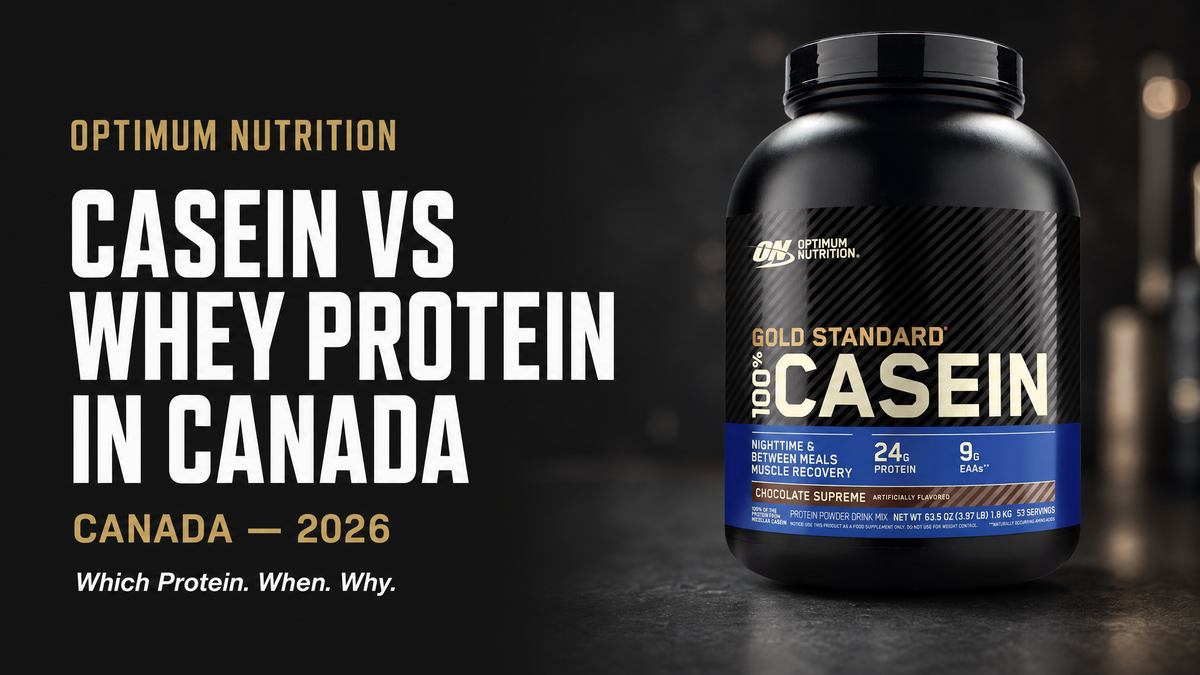
Casein Protein vs Whey in Canada: What’s the Difference? (2026)
By Bulldog Nutrition Editorial Team | Updated: June 2026
Quick Answer
Both casein and whey come from cow's milk — but they digest at completely different speeds. Whey protein absorbs in 1–2 hours, making it ideal post-workout when your muscles need amino acids fast. Casein protein digests slowly over 5–7 hours, making it the better choice before bed or during long gaps between meals. For most Canadians, whey is the everyday workhorse and casein is the overnight recovery tool. You can use both.
Casein and whey are the two proteins found naturally in milk. When milk separates during cheese production, whey becomes the liquid component and casein becomes the solid curd. Both end up as protein powders — but their behaviour in the body is significantly different, and that difference determines when you should use each one.
This guide covers what the research actually says, how to use each protein type practically, and what options are available in Canada.
What Is Whey Protein?
Whey is the fast-digesting fraction of milk protein, making up approximately 20% of total milk protein by weight. Once separated and dried, it becomes whey protein powder — available as concentrate, isolate, or hydrolyzed isolate depending on the level of filtration applied.
Whey is high in leucine, the branched-chain amino acid that directly triggers muscle protein synthesis. Research published in the Journal of Physiology (Churchward-Venne et al., 2012) confirmed that leucine availability is the primary signal for initiating muscle repair and growth. After a workout, whey delivers that signal quickly — amino acid levels peak in the blood within 60–90 minutes and return to baseline within 2 hours.
For a full breakdown of the best whey options available in Canada, see our Best Whey Protein in Canada guide.
What Is Casein Protein?
Casein makes up approximately 80% of milk protein by weight. Unlike whey, casein forms a gel in the stomach when it encounters stomach acid — slowing digestion and creating a steady, prolonged release of amino acids over 5–7 hours. This slow-release profile is called “anticatabolic”: it maintains elevated amino acid levels in the blood for an extended period, reducing muscle protein breakdown during long fasting windows (like sleep).
The most common form used in supplements is micellar casein — the naturally occurring form in milk, preserved through filtration rather than chemical processing. This is the form used in Optimum Nutrition’s 100% Casein, the most widely used casein product in Canada.
Casein vs Whey — Key Differences
| Factor | Whey Protein | Casein Protein |
|---|---|---|
| Source | Milk (liquid whey fraction) | Milk (solid curd fraction) |
| % of milk protein | 20% | 80% |
| Digestion speed | Fast (1–2 hrs) | Slow (5–7 hrs) |
| Peak amino acid release | 60–90 minutes post-intake | Sustained over 5–7 hours |
| Leucine content | Higher | Lower (but still complete) |
| Texture when mixed | Thin, easy to mix | Thick, pudding-like |
| Primary use case | Post-workout recovery | Overnight recovery, appetite control |
| Cost per serving | Lower (more options) | Higher (fewer products) |
When to Take Whey Protein
Whey protein is best used post-workout — within 1–2 hours of training — when muscle protein synthesis is elevated and your body is primed to absorb and use amino acids for repair. The fast absorption rate matches the window when your muscles benefit most from a protein dose.
Whey is also effective as a general daily protein supplement at any time of day. Morning shakes, mid-afternoon snacks, or as a meal complement — the speed of absorption is less critical outside of the post-workout window. For most Canadians, whey covers 80–90% of their supplemental protein needs.
If fat loss is your primary goal, a lean whey isolate (27g protein / ~110 cal) maximizes protein per calorie. See our full guide to the best protein powder for weight loss in Canada.
When to Take Casein Protein
Casein is most effective taken before bed, when you’re entering a 7–8 hour fast. Research published in Medicine & Science in Sports & Exercise (Res et al., 2012) found that 40g of casein consumed 30 minutes before sleep significantly increased overnight muscle protein synthesis and metabolic rate in active men compared to placebo. The slow-release profile keeps amino acids available throughout the night, reducing the muscle catabolism that occurs during extended fasting.
Casein is also a practical tool for appetite control during a calorie deficit. The thick, gel-like texture after mixing — and the 5–7 hour digestion window — produces significantly more satiety than a comparable serving of whey. For women and men managing hunger during a cut, casein before bed addresses the late-night appetite window more effectively than most alternatives.
For women-specific protein recommendations including both whey and casein-blend options, see our best protein powder for women in Canada guide.
Can You Use Both Whey and Casein?
Yes — and this is the approach used by many serious athletes. A common protocol is whey post-workout (fast delivery for immediate recovery) and casein before bed (slow delivery for overnight muscle repair). The two proteins serve different physiological windows and don’t compete with each other.
If budget is a constraint, whey should take priority — its post-workout role is better supported by the research and it covers more use cases. Casein is additive, not a replacement.
A cost-effective middle ground: PEScience Select Protein, a casein-dominant whey blend (milk protein isolate + whey concentrate) that provides slower digestion than pure whey at a lower price than dedicated casein. It’s available in 14 flavours and works well as an afternoon or evening shake for those who want casein’s satiety benefits without the full overnight-only use case. Read our full PEScience Select Protein review →
Casein and Whey Products Available in Canada at Bulldog
| Product | Type | Protein | Best Use |
|---|---|---|---|
| Optimum Nutrition 100% Casein 4lb | Micellar casein | 24g | Before bed, overnight recovery |
| PEScience Select Protein 27 servings | Casein-dominant whey blend | 24g | Evening shake, satiety, appetite control |
| Dymatize ISO 100 5lb | Hydrolyzed whey isolate | 25g | Post-workout, daytime |
| Allmax IsoFlex 5lb | Whey isolate | 27g | Post-workout, daytime |
For the full range of whey protein options, browse our complete protein powder collection. For a detailed breakdown of daily protein targets by bodyweight, see our guide on how much protein per day you need to build muscle.
Is casein protein better than whey for building muscle?
Neither is strictly better — they serve different roles. Whey’s higher leucine content and faster absorption make it the stronger post-workout choice for triggering muscle protein synthesis. Casein’s slow-release profile makes it better for overnight muscle repair and reducing catabolism during sleep. Research consistently shows that using both strategically produces better muscle-building outcomes than relying on whey alone.
Can I take casein protein during the day instead of before bed?
Yes. Taking casein during the day isn’t wrong — it simply means you’re getting slower, sustained amino acid delivery instead of a fast peak. This makes casein a reasonable choice for meal replacement shakes, long stretches between meals, or for managing hunger during a calorie deficit. The before-bed use case is the most researched, but casein is effective whenever sustained release is the goal.
Does casein protein cause bloating in Canada?
Casein is a milk-derived protein and contains lactose, which can cause bloating in people with lactose sensitivity. Micellar casein (the form in Optimum 100% Casein) is generally better tolerated than calcium caseinate, but anyone with significant dairy sensitivity should monitor their response. Whey isolate — which has lactose removed through filtration — is the better option for lactose-sensitive individuals.
Is casein protein worth buying in Canada if I already have whey?
It depends on your goals. If you train hard and recovery is a priority, adding casein before bed is a well-researched strategy for overnight muscle repair. If you’re budget-conscious, prioritize hitting your total daily protein target with whey first — and add casein when it fits. A casein-dominant blend like PEScience Select Protein is a cost-effective way to get the satiety and slow-release benefits without buying a dedicated casein product. See our full PEScience Select Protein review for a detailed breakdown.
What is the difference between micellar casein and casein hydrolysate?
Micellar casein is the naturally occurring form of casein in milk, preserved through cold filtration. It digests slowly (5–7 hours) and is the form used in most nighttime recovery products. Casein hydrolysate is enzymatically broken down like hydrolyzed whey — it absorbs faster but loses the slow-release benefit that makes casein useful before bed. For overnight recovery, micellar casein is the correct form to look for on the label.
Final Thoughts
Casein and whey are complementary, not competitive. Whey delivers amino acids fast when you need them — post-workout, morning, daytime. Casein delivers them slowly when fasting is unavoidable — overnight, or during long gaps between meals. For most Canadian athletes and fitness enthusiasts, whey covers the majority of supplemental protein needs. Casein earns its place as a precision tool for overnight recovery and sustained satiety.
Browse all protein supplements at Bulldog Nutrition — authorized Canadian and US retailer with nationwide shipping and over 10 years in the industry.