
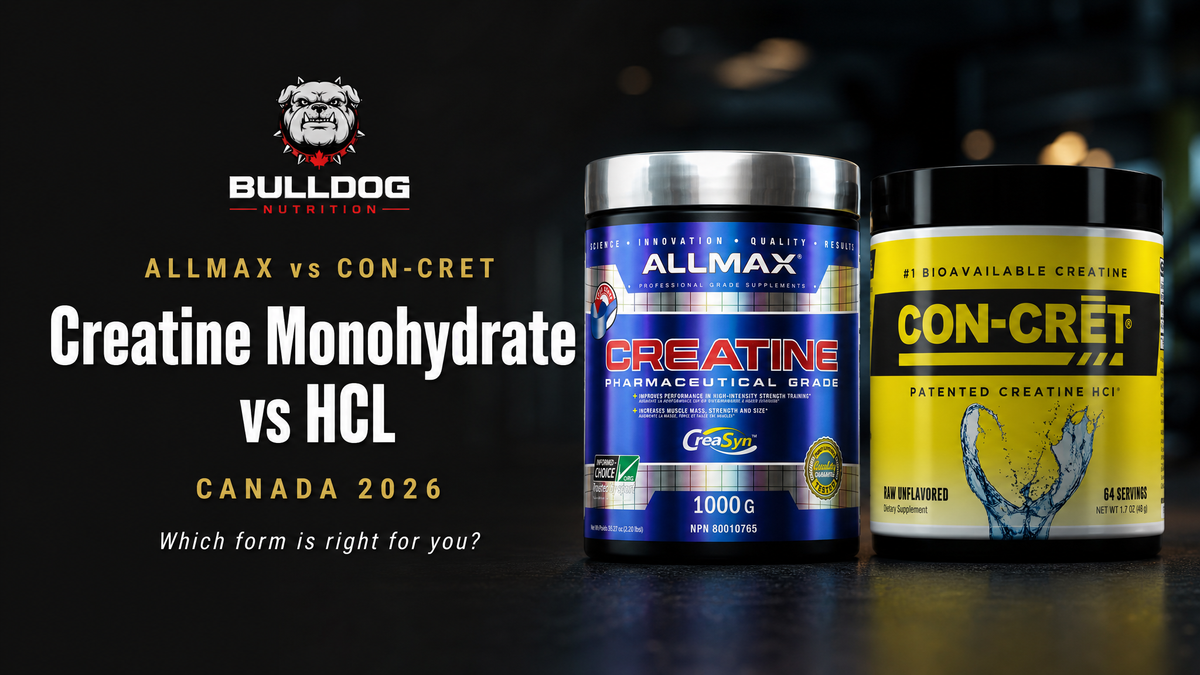
Creatine Monohydrate vs. HCL: Which Form Is Right for Canadians? (2026)
By Bulldog Nutrition Editorial Team | Updated: June 2026
Quick Answer
Creatine monohydrate is the better choice for most Canadians. It has 500+ peer-reviewed studies behind it, costs significantly less per serving, and performs identically to HCL in direct comparison trials. Creatine HCL is a legitimate alternative if you experience bloating or GI discomfort on monohydrate — its superior water solubility allows effective results at lower doses (1–2g vs. 3–5g), but it delivers no performance advantage and costs more per gram.
Supplement marketing will tell you creatine HCL is a next-generation upgrade — more bioavailable, gentler on the stomach, no loading phase required. Some of that is partially true. Most of it is overstated. This guide cuts through the noise with actual research so you can make the right call for your goals, budget, and digestive system. At Bulldog Nutrition, we carry both forms from authorized sources. Here is what the science says before you spend a dollar.
What Is Creatine and Why Does the Form Matter?
Creatine is a compound stored primarily in muscle tissue, where it fuels short-burst, high-intensity effort — heavy lifts, sprints, explosive movements. Your body produces roughly 1–2g per day, and you get additional creatine from red meat and fish. Supplementing tops up those stores, allowing you to train harder, recover faster between sets, and accumulate more training volume over time. Both monohydrate and HCL deliver creatine to your muscles — the form refers to what molecule creatine is bonded to, which affects solubility, dose size, and GI tolerability, not the fundamental mechanism by which creatine works.
Creatine Monohydrate: The Gold Standard
Creatine monohydrate is the most studied supplement in sports nutrition history. Over 500 peer-reviewed studies have examined its safety, efficacy, and dosing. The International Society of Sports Nutrition (ISSN) has formally classified creatine monohydrate as the most effective ergogenic nutritional supplement currently available for increasing high-intensity exercise capacity and lean body mass.
- Increases muscle phosphocreatine stores by 20–40% with regular supplementation
- Improves strength, power output, and performance in short-burst activities
- Supports lean muscle gain when combined with resistance training
- Safe for long-term continuous use — no credible evidence of kidney or liver harm at standard doses in healthy adults
- Recognized by Health Canada as a Natural Health Product (NHP)
The main drawback: a subset of users experience mild bloating or GI discomfort, particularly during a loading phase. Standard dose is 3–5g per day, with an optional loading phase of 20g/day for 5–7 days to saturate stores faster.
Creatine HCL: What the Marketing Doesn't Tell You
Creatine HCL bonds creatine to a hydrochloride salt, increasing its water solubility approximately 38–40 times higher than monohydrate. Manufacturers claim it requires a smaller dose (1–2g vs. 3–5g) and is better tolerated by people with sensitive stomachs. Where the marketing overreaches: improved solubility does not automatically translate to greater muscle uptake or better performance. Muscle saturation — not GI absorption — is the rate-limiting step. Worth noting: creatine HCL is approximately 78% creatine by mass versus approximately 88–90% for monohydrate, so a 1.5g HCL dose delivers less actual creatine than 1.5g of monohydrate.
Head-to-Head Comparison
| Feature | Creatine Monohydrate | Creatine HCL |
|---|---|---|
| Research backing | 500+ peer-reviewed studies | Limited direct comparison data |
| Daily dose | 3–5g | 1–2g |
| Creatine by mass | ~88–90% | ~78% |
| Water solubility | Standard | ~38–40x higher |
| GI tolerance | Good for most; some mild bloating | Generally well tolerated; lower GI impact |
| Loading phase | Optional | Not required |
| Cost per serving | Low | Higher |
| Performance outcome | Gold standard | Comparable in head-to-head trials |
| Best for | Most users | GI-sensitive users or those who prefer a smaller dose |
What Does the Research Actually Say?
In 2025, a placebo-controlled randomized clinical trial published in the Journal of the International Society of Sports Nutrition directly compared creatine monohydrate and creatine HCL in 31 elite team-sport athletes over 8 weeks — both groups dosed at 5g per day. Both forms produced comparable improvements in jump performance and fat-free mass with no statistically significant differences between them. Only the monohydrate group showed significant increases in fat-free mass index. The researchers concluded: "Claims of Cr-HCl superiority are unfounded and misleading." (Londoño-Velásquez et al., 2025, JISSN)
When to Choose HCL Over Monohydrate
HCL earns its place for a specific user. Consider it if you have tried monohydrate and consistently experience bloating, cramping, or GI discomfort; if you prefer a smaller scoop mixed into a pre-workout; or if you want a compact, low-dose option for travel. For everyone else — beginners, intermediate lifters, and experienced athletes who tolerate monohydrate well — monohydrate delivers identical results at a fraction of the cost.
Best Creatine Options in Canada
Bulldog Nutrition carries both forms sourced directly from the brand — never grey market, never counterfeit. Best monohydrate: Allmax 100% Pure Creatine — micronized monohydrate, 200 servings per 1,000g tub. Best HCL: CON-CRET Creatine HCL — 750mg–1.5g per serving, highly soluble, ideal for users who experience digestive discomfort on monohydrate. Browse our full creatine collection — monohydrate, HCL, gummies, and capsules all in stock.
Shop now: Bulldog Nutrition is an authorized Canadian and US retailer — 10+ years in business, ships to all provinces. Shop Creatine
How to Take Creatine
Dose: 3–5g of monohydrate daily; 1–2g of HCL daily. Consistency matters more than timing — pre- or post-workout both work. Creatine draws water into muscle cells, so drink at least 2–3 litres of water per day while supplementing. See our full guide on how much water to drink with creatine. A loading phase (20g/day for 5–7 days, then 3–5g maintenance) is optional for monohydrate and not required for HCL. Neither form requires cycling.
Frequently Asked Questions
Is creatine HCL more effective than monohydrate?
No. A 2025 randomized controlled trial in the Journal of the International Society of Sports Nutrition found no statistically significant performance difference between the two forms in elite athletes. The researchers stated that claims of HCL superiority are "unfounded and misleading." HCL is easier on the digestive system for sensitive users but does not outperform monohydrate for strength, power, or body composition.
Why does creatine HCL require a smaller dose?
Creatine HCL is approximately 38–40 times more water-soluble than monohydrate, so it dissolves and is absorbed through the GI tract more efficiently. A smaller dose achieves adequate uptake without leaving undissolved particles that can irritate the stomach. Note that HCL contains less creatine by mass (~78%) than monohydrate (~88–90%), so the actual creatine delivered per gram is slightly lower.
Is creatine HCL better for women?
Not specifically — both forms work equally well for women. Some women prefer HCL because the smaller dose is more convenient and causes less bloating. For a full breakdown: Is Creatine Safe for Women?
Do I need to load creatine HCL?
No. A loading phase is not necessary for creatine HCL. Higher solubility means muscle stores saturate gradually without a high-dose saturation phase. For monohydrate, a loading phase is optional — it speeds up initial results by roughly a week but does not change the long-term outcome.
Where can I buy creatine monohydrate and HCL in Canada?
Bulldog Nutrition is an authorized Canadian and US retailer carrying both forms from trusted brands including Allmax and CON-CRET. Browse our full selection at bulldognutrition.com/collections/creatine — ships to all provinces and the United States.
Final Thoughts
Creatine monohydrate is the right choice for most people — the most studied, most affordable, and most proven form available. Direct comparison trials show HCL offers no performance advantage. HCL is a legitimate option for users with genuine digestive sensitivity, but marketing claims of superiority are not supported by the evidence. Pick the form you will take consistently. Both will work.
Shop our complete creatine range at Bulldog Nutrition — authorized Canadian and US retailer with 10+ years of service and fast nationwide shipping. Shop Creatine