
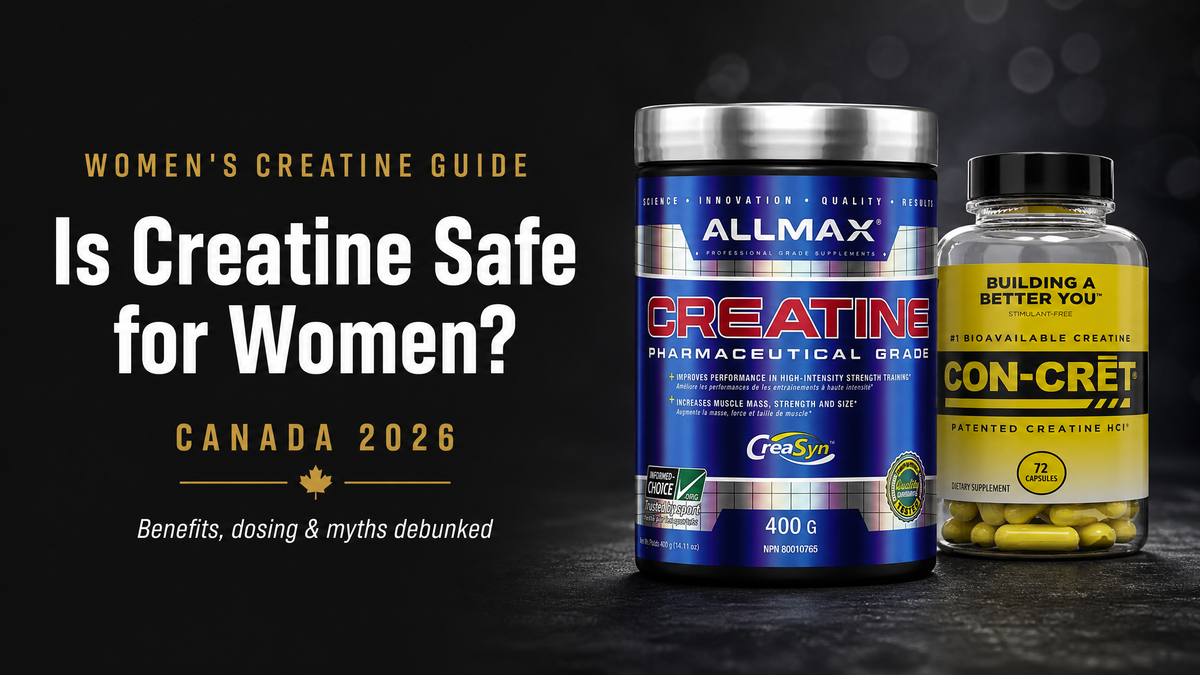
Is Creatine Safe for Women? Benefits, Dosing & Myths Debunked (2026 Canada Guide)
By Bulldog Nutrition Editorial Team | Updated: June 2026
Quick Answer
Yes — creatine is safe for women. Over 500 peer-reviewed studies confirm its safety in healthy adults, and a 2025 review published in the Journal of the International Society of Sports Nutrition concluded that creatine supplementation is not only safe for women but may offer specific benefits across different life stages — menstruation, perimenopause, and menopause. The recommended dose is 3–5g of creatine monohydrate per day. No cycling required.
Not long ago, creatine was treated as a men's supplement — something for powerlifters and football players, not the average woman training three times a week. That perception has shifted significantly in the research community. Researchers have spent the past decade specifically studying how creatine affects women, and the findings go well beyond a simple safety confirmation: women may benefit from creatine in ways that are distinct from — and in some cases greater than — the benefits men experience.
Why Women Have Been Slow to Adopt Creatine
The hesitation is understandable. Creatine's reputation for causing bulk, bloating, and a masculine physique has kept many women away from it. None of those concerns hold up under scrutiny. Women also naturally store approximately 70–80% of the creatine that men store — partly because of proportionally less muscle mass, and partly because women tend to consume less red meat, the primary dietary source of creatine. This lower baseline means women may actually experience a relatively larger benefit from supplementation, bringing their stores up from a lower starting point.
The Safety Evidence Is Unambiguous
Health Canada classifies creatine monohydrate as a Natural Health Product (NHP) — available without a prescription, with no identified serious adverse effects in healthy adults at standard doses. A comprehensive 2025 review, "Creatine in women's health: bridging the gap from menstruation through pregnancy to menopause" (Journal of the International Society of Sports Nutrition), examined decades of creatine research in female populations and concluded that creatine is safe for ongoing use in healthy women, with no evidence of kidney or liver harm at doses of 3–5g per day, no hormonal disruption or androgenic effects, and no need for cycling. The ISSN position stand classifies creatine monohydrate as the most effective ergogenic nutritional supplement currently available — a classification that applies equally to women.
Benefits of Creatine That Are Especially Relevant for Women
Strength and training performance. Creatine increases phosphocreatine stores in muscle, which directly fuels ATP regeneration during high-intensity training — faster recovery between sets, more training volume per session, compounded strength gains over weeks and months. Women tend to have a higher proportion of Type I muscle fibres and lower circulating testosterone, which can slow strength adaptation. Creatine helps close that gap.
Cognitive benefits during hormonal shifts. A 2025 randomized controlled trial found that creatine supplementation in perimenopausal and menopausal women significantly improved reaction time and increased frontal brain creatine levels compared to placebo. Research has also found an inverse relationship between dietary creatine intake and depression scores in women. The brain is creatine-hungry during periods of hormonal flux, and supplementation appears to support cognitive function and mood stability.
Sleep quality after training. A 2024 study (PMC11357324) found that creatine supplementation improved total sleep duration in naturally menstruating women following resistance training days. Resistance exercise temporarily depletes muscle and brain creatine stores — supplementation supports faster overnight restoration.
Menstrual cycle interaction. A 2024 population-based study found that women with higher dietary creatine intake were more likely to have regular menstrual cycles. The relationship is observational and not yet causal, but it adds context to the broader picture of creatine supporting energy metabolism in female physiology.
Shop now: Browse our full creatine range at Bulldog Nutrition — monohydrate, HCL, gummies, and capsules all in stock from authorized sources. Shop Creatine
Creatine Myths — Debunked for Women
"Creatine will make me look bulky." Creatine does not build muscle independently. Building significant muscle mass requires months of progressive overload plus a calorie surplus — creatine delivers neither on its own. Women who use creatine without dramatically changing their training or diet will get stronger without meaningful changes in body size.
"Creatine causes bloating and water retention." Creatine draws water into muscle cells — this is intracellular water retention, not the subcutaneous bloating associated with high-sodium diets or hormonal changes. Most women experience no noticeable visual difference. If you are sensitive to monohydrate, creatine HCL at 1–2g per day is a valid alternative with less digestive impact.
"Creatine is a steroid." Creatine is not a steroid and has no androgenic effects. It does not influence testosterone, estrogen, or any sex hormone at standard doses. It is a naturally occurring compound synthesized daily by your liver and kidneys, and found in meaningful amounts in red meat and fish.
"It will damage my kidneys." Extensive research in healthy individuals has found no evidence of kidney or liver harm at 3–5g per day. If you have a pre-existing kidney condition, consult your physician before supplementing. For healthy adults, the long-term safety record is well established.
"I need to cycle on and off." No cycling is required. Creatine is not hormonal and does not cause receptor downregulation. Daily supplementation is the most effective and most practical approach.
How Much Creatine Should Women Take?
The research-supported dose is identical for women and men:
| Approach | Protocol | Notes |
|---|---|---|
| Standard (recommended) | 3–5g per day, no loading | Muscle stores saturate over 3–4 weeks. Simplest approach. |
| Loading phase (optional) | 20g/day in 4 doses for 5–7 days, then 3–5g | Saturates stores faster. Increases GI discomfort risk during loading. |
| Lower bodyweight | 3g per day | Suitable for women under approximately 60kg / 130lbs. |
| HCL alternative | 1–2g per day | For users who experience bloating on monohydrate. |
Timing is less important than consistency. Taking creatine at the same point in your daily routine — with a meal, a protein shake, or post-workout — is the most practical approach. For hydration guidance, see our guide on how much water to drink with creatine.
Best Creatine for Women in Canada
We’ve published a full ranked guide to the best creatine for women in Canada (2026) with our top picks by goal.
For most women, creatine monohydrate is the right starting point — the most studied, most affordable, and most available form in Canada. Best monohydrate: Allmax 100% Pure Creatine — unflavoured, mixes cleanly, 200 servings per 1,000g tub. Best for GI sensitivity: CON-CRET Creatine HCL — 750mg–1.5g per serving, highly soluble, lower bloating potential. For a full comparison: Best Creatine Supplements in Canada (2026).
Frequently Asked Questions
Is creatine safe for women to take long-term?
Yes. Multiple long-term studies in healthy adults — including women — show no adverse effects at 3–5g per day. Health Canada classifies creatine monohydrate as a Natural Health Product, and the ISSN has formally stated that long-term creatine supplementation is safe and effective. No cycling is required.
Will creatine affect my hormones or menstrual cycle?
Creatine does not affect estrogen, testosterone, or other sex hormones at standard doses. There is no evidence that creatine disrupts the menstrual cycle. Observational data published in 2024 suggests that women with higher creatine stores may actually be more likely to have regular cycles, though this is preliminary and not yet a causal finding.
Can I take creatine while pregnant or breastfeeding?
Consult your physician or OB-GYN before supplementing during pregnancy or breastfeeding. While creatine is naturally synthesized by the body and consumed through food, the clinical research in pregnant or breastfeeding women is not sufficient to make a population-level recommendation. This is a precautionary position, not a contraindication — medical guidance is appropriate here.
How long does it take for creatine to work for women?
Without a loading phase, expect noticeable training improvements within 3–4 weeks of consistent daily supplementation as muscle creatine stores gradually saturate. With a loading phase (20g/day for 5–7 days), effects may begin within 1–2 weeks. Consistency matters more than timing — missing days extends the saturation timeline.
Which creatine form is best for women — monohydrate or HCL?
Both forms deliver equivalent results. Creatine monohydrate is the first choice for most women — lower cost, more research backing, same performance outcome. Creatine HCL is a good alternative if you experience bloating on monohydrate. For a full breakdown: Creatine Monohydrate vs. HCL Canada.
The hair-loss question comes up constantly with creatine — here's what the research actually shows.
Final Thoughts
The short answer has always been yes — creatine is safe for women. But the research of the past few years makes the conversation far more interesting than a simple safety confirmation. There are now legitimate, evidence-backed reasons to think creatine offers particular value to women: cognitive protection during perimenopause, sleep quality support after training, and a lower baseline creatine store that makes supplementation relatively more impactful. If you have been avoiding creatine because of myths about bulk, bloating, or hormones — the evidence says those concerns are worth revisiting.
Shop our creatine collection at Bulldog Nutrition — authorized Canadian and US retailer with 10+ years serving supplement customers nationwide. Shop Creatine