
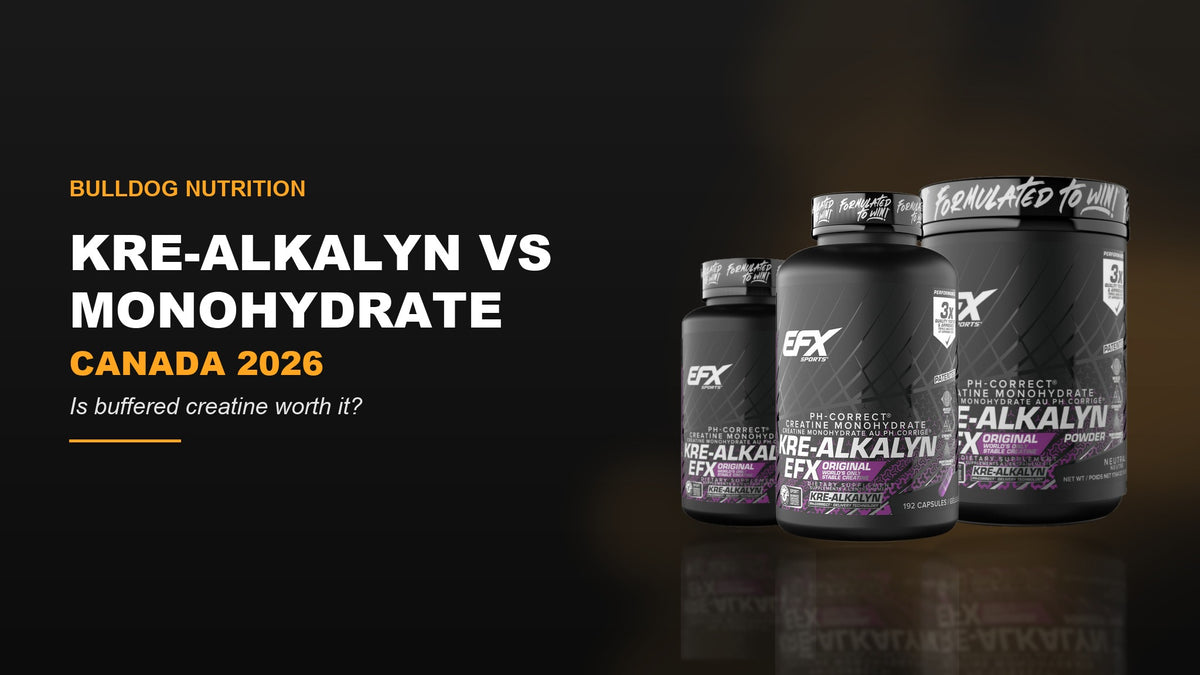
Kre-Alkalyn vs Creatine Monohydrate: Is Buffered Creatine Worth It? (Canada 2026)
By Bulldog Nutrition Editorial Team | Updated: November 2026
Quick Answer
Kre-Alkalyn is creatine monohydrate that EFX Sports buffers to a high pH, sold as a 1.5 g capsule or scoop dose with no loading phase on the label. The one peer-reviewed head-to-head trial (Jagim and colleagues, 2012) found it did not raise muscle creatine, strength, anaerobic capacity or lean mass more than plain monohydrate, and did not produce fewer side effects. It is worth it if you want a small capsule dose with no loading or mixing; plain monohydrate is the reference form and the lower-cost gram. Bulldog Nutrition is an authorized Canadian and US retailer of both, with nationwide shipping.
Search "kre alkalyn" in Canada and the results split in two. Retail pages call it a stabilized, more efficient creatine with no loading and no bloating; a PubMed entry a few results down carries a title that says the opposite. Before you choose between EFX Kre-Alkalyn and a tub of monohydrate, here is which story the evidence supports.
Sources: the full text of the Jagim trial, the ISSN's 2017 creatine position stand and a 2011 review of creatine stability, plus label numbers from the EFX Sports product page and the three Kre-Alkalyn listings at Bulldog Nutrition. Claims about how the product works are attributed to EFX.
Browse all creatine supplements at Bulldog Nutrition →
What Is Kre-Alkalyn, and How Is It Different From Creatine Monohydrate?
Kre-Alkalyn is a patented creatine monohydrate made by EFX Sports in the United States. The EFX supplement facts panel lists one active ingredient, "Kre Alkalyn (buffered creatine monohydrate)", at 1,500 mg per two-capsule serving; the molecule doing the work is still creatine monohydrate, and what changes is the pH of the powder.
EFX states that its scientist, Dr. Jeff Golini, found that buffering creatine to pH 12 produced a more stable molecule. According to EFX, ordinary creatine partly converts to creatinine, an inactive by-product, in stomach acid; the buffered version resists that conversion, so more active creatine reaches muscle per gram, no loading is needed and users who had stomach upset on regular monohydrate report fewer issues. Those are the brand's statements; the next two sections test them.
Plain creatine monohydrate is the form behind nearly every creatine study ever run. The ISSN position stand calls it "the most effective ergogenic nutritional supplement currently available to athletes", dosed at 3–5 g a day with an optional loading week. Our creatine monohydrate vs HCL guide covers the other common alternative stocked in Canada.
What Did the Published Trial Actually Find?
In 2012 a Texas A&M University team led by Andrew Jagim and Richard Kreider ran the only peer-reviewed, double-blind comparison of the two we could find. Thirty-six resistance-trained men, average age 20, were split into three groups for 28 days:
- Creatine monohydrate (CrM): 20 g a day (four 5 g doses) for 7 days, then 5 g a day for 21 days.
- Kre-Alkalyn, label dose (KA-L): 1.5 g a day for all 28 days, matching the EFX label.
- Kre-Alkalyn, matched dose (KA-H): the same 20 g loading and 5 g maintenance schedule.
Biopsies, blood work, DEXA scans, one-rep maxes and Wingate anaerobic tests ran at days 0, 7 and 28. Muscle free creatine rose in all three groups with no statistically significant difference between them: about 50% in the monohydrate group by day 28, about 27% in the matched-dose Kre-Alkalyn group and about 12% in the label-dose group (not statistically significant). Body composition, bench press strength and anaerobic work all improved over time with no differences among groups, and no side effects were reported. The authors concluded that neither the 1.5 g label dose nor a matched loading dose of Kre-Alkalyn "promoted greater changes in muscle creatine content, body composition, strength, or anaerobic capacity than CrM", and that "there was no evidence that supplementing the diet with a buffered form of creatine resulted in fewer side effects".
Two caveats belong in an honest summary: the trial was funded by AlzChem, maker of the Creapure monohydrate it tested, which the authors disclose; and EFX cites a 2006 Bulgarian weightlifting study on its product page that the Jagim authors could not locate in peer-reviewed indexes. The ISSN's 2017 position stand cites the Jagim trial as its reference on buffered creatine.
Does Creatine Really Break Down in Your Stomach?
This is the claim everything rests on. Creatine monohydrate powder is very stable: a 2011 review in Amino Acids by Jäger and colleagues reports no measurable degradation after more than three years at room temperature. In water it breaks down faster the lower the pH (after three days at 25°C, about 4% converts to creatinine at pH 5.5 and 21% at pH 3.5), which is why creatine is sold dry and a shake should be drunk soon after mixing.
The stomach is different. At very low pH the creatine molecule is protonated in a way that blocks the reaction that forms creatinine. In the ISSN's words, degradation in solution "does not mean that creatine is degraded into creatinine in vivo through the digestive process"; conversion in the gut "has been reported to be minimal regardless of transit time", close to 99% of ingested monohydrate is taken up by muscle or excreted in urine, and claims that other forms are degraded less or taken up more are "currently unfounded".
Put simply, the problem Kre-Alkalyn is designed to solve appears small to begin with. It is still monohydrate and the trial shows it works; the buffering is a format choice, not a potency upgrade.
Kre-Alkalyn vs Creatine Monohydrate: How Do They Compare?
| Feature | Creatine monohydrate | Kre-Alkalyn (EFX) |
|---|---|---|
| What it is | Creatine bonded to one water molecule; about 88% creatine by weight | Creatine monohydrate buffered to a high pH (EFX states pH 12); patented by EFX Sports |
| Evidence base | Hundreds of peer-reviewed trials; the ISSN's reference form | One peer-reviewed head-to-head trial (Jagim 2012): equal outcomes, no fewer side effects |
| Typical dose | 3–5 g a day (ISSN); larger athletes may need 5–10 g | 1.5 g per 2 capsules or 1 scoop; EFX directs 2 caps before and 2 after training |
| Loading phase | Optional: about 20 g a day for 5–7 days, or 3–5 g a day for 3–4 weeks | Not required per the label; no advantage found at the label dose or a matched loading dose |
| Format | Mostly unflavoured powder; also gummies and capsules | Gelatin capsules (120 or 192) or 500 g unflavoured powder |
| Cost tier | Lowest cost per gram of creatine | Higher cost per gram; you pay for the small dose and capsules |
Neither form wins on how much creatine ends up in your muscle.
How Much Kre-Alkalyn Should You Take, and Do You Need to Load?
Per the EFX label, a serving is two capsules or one scoop, delivering 1,500 mg. EFX's suggested use is two capsules 30 minutes before training and two after, or 3 g on training days; the Bulldog Nutrition listings add two capsules with breakfast, or half a powder serving, on rest days.
The ISSN notes that 3 g a day of monohydrate for 28 days reaches the same muscle creatine level as a loading week, just more slowly. In the Jagim trial the 1.5 g-a-day group showed the smallest rise at 28 days, which fits the rule that total daily creatine, not form, drives saturation; if you choose Kre-Alkalyn, take the full training-day dose. See how much creatine to take per day for the 3–5 g range and bigger athletes, and our creatine loading phase guide for whether a loading week is ever worth it.
Which EFX Kre-Alkalyn Should You Buy in Canada?
Bulldog Nutrition stocks three formats, all at the same 1,500 mg serving; the differences are count, capsule versus powder, and gelatin.
| Product | Format | Per serving | Serving | Servings | Vegan |
|---|---|---|---|---|---|
| EFX Kre-Alkalyn 192 Caps | Gelatin capsules | 1,500 mg | 2 capsules (750 mg each) | 96 | No |
| EFX Kre-Alkalyn 120 Caps | Gelatin capsules | 1,500 mg | 2 capsules (750 mg each) | 60 | No |
| EFX Kre-Alkalyn Powder 500 g | Unflavoured powder | 1,500 mg | 1 scoop (1.5 g) | 250 | Yes, per the listing |
EFX Kre-Alkalyn 192 Caps
192 capsules at 750 mg each, or 96 two-capsule servings, roughly two months on EFX's schedule. The label lists maltodextrin, magnesium stearate and a gelatin shell, so it is not vegan. Pick it once you have settled on Kre-Alkalyn and want the fewest reorders. See EFX Kre-Alkalyn 192 Caps at Bulldog Nutrition.
EFX Kre-Alkalyn 120 Caps
Same capsule, same 750 mg, in a 60-serving bottle: the sensible first purchase for testing whether a small-dose capsule suits you better than a scoop. The label lists gelatin, maltodextrin, magnesium stearate and FD&C colouring. Not vegan. See EFX Kre-Alkalyn 120 Caps at Bulldog Nutrition.
EFX Kre-Alkalyn Powder 500 g
250 servings of 1.5 g in one tub, with the flexibility to scale the dose. It is the only gelatin-free Kre-Alkalyn format at Bulldog Nutrition; the listing describes the Neutral version as vegan and gluten-free. Drink it soon after mixing. See EFX Kre-Alkalyn Powder 500 g at Bulldog Nutrition.
Who Should Pick Kre-Alkalyn, and Who Should Stick With Monohydrate?
Pick creatine monohydrate if you want the deepest research record, the lowest cost per gram and a simple 3–5 g scoop: the default for beginners, for anyone loading before a meet, and for larger athletes who may need 5–10 g a day, where capsules become impractical.
Pick Kre-Alkalyn if you prefer capsules, want a label that never asks you to load, or found the monohydrate loading week hard on your stomach. The trial found no side effects in either group, so a lifter who takes it consistently is getting a creatine that works. If loading-week bloating is your real concern, the cheaper fix is to skip the load and take 3–5 g of monohydrate a day; you reach the same saturation in three to four weeks.
Is Kre-Alkalyn Safe, and Is It Tested for Banned Substances?
The safety picture is that of creatine monohydrate, because that is what it is: the ISSN finds no compelling evidence that use up to 30 g a day for five years harms otherwise healthy individuals, and in the Jagim trial Kre-Alkalyn at both doses produced the same clinical blood markers as monohydrate with no reported side effects.
On drug testing: EFX states that Kre-Alkalyn is tested for banned substances and names a third-party testing program on its product page. We could not confirm a current listing in that program's public database, so if you compete in a tested sport, check the certifier's database for the exact product and lot first.
⚠️ Always read the full label before use. Consult a health care practitioner before use if you have a kidney disorder, are pregnant or breastfeeding, or are under 18. These statements have not been evaluated by Health Canada or the FDA for disease treatment or prevention.
FAQ
Is Kre-Alkalyn better than creatine monohydrate?
Not on the published evidence. The one peer-reviewed head-to-head trial (Jagim et al., 2012) found the same changes in muscle creatine, strength, anaerobic capacity and body composition over 28 days, with no difference in side effects. Kre-Alkalyn is a legitimate creatine monohydrate in a small-dose capsule format, not a stronger one.
What is Kre-Alkalyn good for?
The same things as any creatine: supporting strength, power and repeated high-intensity efforts, plus the lean-mass gains that come with harder training. Its practical advantages are a 1.5 g serving, capsules and no loading phase.
How much Kre-Alkalyn should I take a day?
Follow the EFX label: two capsules (1,500 mg) 30 minutes before training and two after, or 3 g on training days, and two capsules at breakfast on rest days. In the trial, 1.5 g a day showed the smallest rise in muscle creatine, so take the full training-day dose.
Does Kre-Alkalyn cause bloating or side effects?
EFX states it is designed to avoid the bloating some people report on monohydrate. In the trial no side effects were reported in any group, and the authors found no evidence of fewer side effects with the buffered form; most bloating reports come from the optional 20 g-a-day loading week.
Do I need to load Kre-Alkalyn?
No. The EFX label has no loading phase, and in the trial a matched 20 g-a-day week of Kre-Alkalyn offered no advantage over monohydrate loading. Expect muscle stores to build over three to four weeks at the label dose.
Where can I buy Kre-Alkalyn in Canada?
Bulldog Nutrition is an authorized Canadian and US retailer of EFX Sports and stocks the 120-capsule, 192-capsule and 500 g powder formats, with nationwide shipping.
Final Thoughts
Kre-Alkalyn is creatine monohydrate with a higher pH, a patent and a convenient 1.5 g serving. The published trial says it works about as well as plain monohydrate, and no better; the stability research says the problem it was built around is small. For Canadian lifters the choice is simple: monohydrate for the deepest evidence and lowest cost per gram, or Kre-Alkalyn for capsules, no loading and a tiny daily dose. Both are stocked at Bulldog Nutrition, an authorized Canadian and US retailer, with fast nationwide shipping.
Research References
- Jagim AR, Oliver JM, Sanchez A, et al. A buffered form of creatine does not promote greater changes in muscle creatine content, body composition, or training adaptations than creatine monohydrate. Journal of the International Society of Sports Nutrition, 2012;9:43. Conference abstract: J Int Soc Sports Nutr, 2012;9(Suppl 1):P11.
- Kreider RB, Kalman DS, Antonio J, et al. International Society of Sports Nutrition position stand: safety and efficacy of creatine supplementation in exercise, sport, and medicine. Journal of the International Society of Sports Nutrition, 2017;14:18.
- Jäger R, Purpura M, Shao A, Inoue T, Kreider RB. Analysis of the efficacy, safety, and regulatory status of novel forms of creatine. Amino Acids, 2011;40(5):1369–1383.
- EFX Sports. Kre Alkalyn EFX product page: supplement facts and suggested use. efxsports.com (archived copy), accessed 2026.