
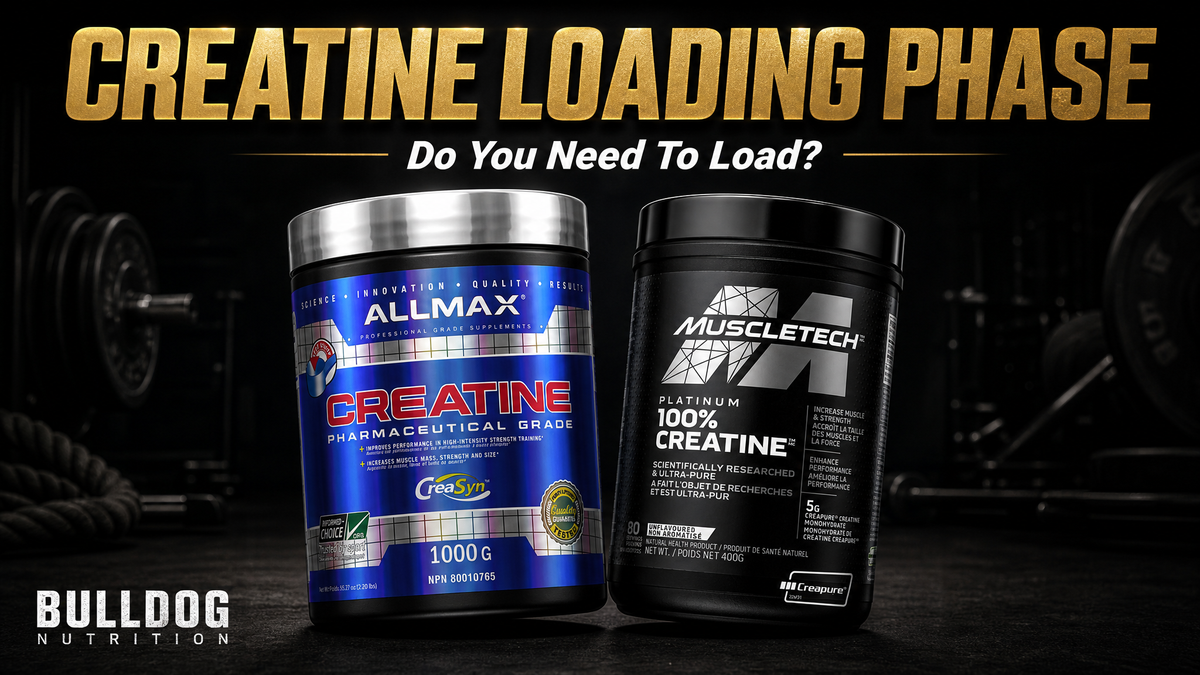
Creatine Loading Phase: Do You Need It? Complete Canadian Guide (2026)
By Bulldog Nutrition Editorial Team | Updated: June 2026
Quick Answer
The creatine loading phase — 20g/day for 5–7 days — is a legitimate but optional strategy. Loading saturates your muscles faster (within 7 days vs. 28 days for standard dosing), but both approaches deliver identical long-term results. For most Canadians, a simple 5g/day maintenance dose is the smarter starting point: fewer side effects, same final outcome. Load only if you have a specific performance deadline within 2–3 weeks.
Creatine is one of the few supplements with enough research behind it to recommend to nearly anyone who trains. But when you start looking into how to take it, you hit a wall of conflicting advice: load up with 20 grams a day, or just take 5 grams and wait? The loading phase debate has been going on in supplement circles for decades.
This guide cuts through the noise. We'll cover what the research actually says about creatine loading, who it makes sense for, and the exact protocols to follow — whether you choose to load or not.
What Is the Creatine Loading Phase?
The creatine loading phase is a short-term, high-dose protocol designed to rapidly saturate your muscle creatine stores. The standard loading protocol, as recommended by the International Society of Sports Nutrition (ISSN), involves:
- 20–25g of creatine per day for 5–7 days
- Split into 4–5 doses of 5g spread throughout the day
- Followed by a standard maintenance dose of 3–5g per day indefinitely
The reason for splitting doses: creatine is most efficiently absorbed in smaller amounts. A single 20g dose is harder for the body to process than four 5g doses spaced through the day.
After the loading period, muscle creatine stores are fully saturated — and they stay saturated on just 3–5g daily thereafter.
Loading vs. No Loading: What the Research Says
The central question: does loading actually matter?
Short answer: loading gets you there faster, but not further.
Research established that a gradual approach — 3g per day for 28 days — achieves the same muscle creatine saturation as a loading protocol (Green et al., 1996, as cited in the ISSN Position Stand on Creatine). Loading simply compresses that 28-day window into 5–7 days.
According to the ISSN, loading increases muscle creatine concentrations by 20–40% within the first week of supplementation. The same 20–40% increase is achieved without loading — it just takes 3–4 weeks instead of one.
The bottom line: if you need results fast — say, you have a competition or training camp in two weeks — loading makes sense. If you're supplementing for long-term strength and performance, the gradual approach works just as well with fewer side effects.
The Three Protocols: Full Load, Micro-Load, or Maintenance Only
| Protocol | Daily Dose | Time to Saturation | Best For | Side Effect Risk |
|---|---|---|---|---|
| Full Load | 20–25g/day (4–5 × 5g) for 5–7 days, then 3–5g/day | 5–7 days | Athletes with a performance deadline within 2–3 weeks | Higher — water retention, possible GI issues |
| Micro-Load | 10g/day (2 × 5g) for 10–14 days, then 3–5g/day | ~14 days | Those who want faster results but are GI-sensitive | Moderate |
| Maintenance Only | 3–5g/day from day one | ~28 days | Most people — best tolerance, simplest routine | Lowest |
For the vast majority of Canadians, the Maintenance Only protocol is the recommended starting point. You will reach the same endpoint — it just takes an extra three weeks to get there.
How to Do the Creatine Loading Phase (Step-by-Step)
If loading fits your timeline, here's the exact protocol:
Days 1–7 (Loading Phase):
- Take 5g of creatine 4 times per day — morning, midday, afternoon, and evening
- Take each dose with water, juice, or a carbohydrate-containing drink (carbs can enhance creatine uptake)
- Eat food with at least some of your doses to reduce GI irritation
- Stay well-hydrated — aim for at least 3–4L of water per day during loading (see our complete creatine hydration guide)
Day 8 Onward (Maintenance Phase):
- Take 3–5g once per day — timing is irrelevant, consistency is what counts
- Continue indefinitely; there is no need to cycle off creatine
Weight-based dosing: The ISSN recommends 0.3g per kg of bodyweight per day during loading. For an 80kg person, that's 24g/day. For simplicity, 20g/day works for most people in the 65–90kg range.
Best products for loading: Allmax 100% Pure Creatine 1000g (200 full 5g servings — the ideal bulk buy for a loading protocol) or MuscleTech Platinum 100% Creatine (micronized, ultra-pure monohydrate — 80 full 5g servings).
Not sure which creatine form is right for you? See our full Monohydrate vs. HCL breakdown →
Should You Load? (Who It Makes Sense For)
Load if you:
- Have a competition, combine, or training camp within 2–3 weeks
- Want to feel creatine's effects as quickly as possible
- Have used creatine before and know you tolerate higher doses without GI issues
- Are restarting after a break and want to re-saturate quickly
Skip loading if you:
- Are new to creatine — minimize side effects while your body adapts
- Have had GI discomfort with creatine in the past
- Are using creatine HCL (such as CON-CRET) — HCL does not require a loading phase due to its higher bioavailability at smaller doses
- Have no immediate performance deadline
Note for women: A standard 3–5g daily maintenance dose is well-studied and fully effective for women. Loading is not required. Read our complete women's creatine guide →
Side Effects of Loading (And How to Minimize Them)
The loading phase carries a higher risk of side effects than standard dosing:
Water retention: The most common effect. Creatine draws water into muscle cells, which can cause a temporary 1–3kg increase in body weight during the loading week. This is intracellular water — it contributes to the full, pumped appearance creatine users notice and stabilizes once you transition to maintenance dosing.
GI discomfort: Stomach cramping, bloating, nausea, or diarrhea can occur with 20g/day if doses aren't managed properly. Splitting doses and taking them with food dramatically reduces this risk.
How to minimize both:
- Split your daily loading dose into at least 4 × 5g doses — never take 10–20g at once
- Take each dose with a meal or snack, not on an empty stomach
- Drink at least 3–4L of water per day during the loading week
- If symptoms are significant, drop to a micro-load (10g/day) or switch to maintenance-only dosing
The ISSN has confirmed that creatine supplementation up to 30g/day for up to 5 years is safe for healthy adults. Short-term loading at 20–25g/day is well within the documented safety range.
Find your creatine at Bulldog Nutrition — authorized Canadian retailer with nationwide shipping →
Frequently Asked Questions
Do I need to do a loading phase to see results from creatine?
No. The creatine loading phase is optional. Taking 3–5g per day from day one achieves the same muscle creatine saturation as a loading protocol — it just takes approximately 28 days instead of 5–7 days. Both approaches produce identical long-term results once saturation is reached.
What happens if I miss a dose during the loading phase?
Missing one dose won't derail your protocol. Creatine loading works through cumulative intake over the full loading week, not a single perfect day. If you miss a dose, resume your normal loading schedule at the next meal. There's no need to extend the loading period.
Can I use creatine HCL for the loading phase?
No — creatine HCL (like CON-CRET) does not require a loading phase. Its higher water solubility allows effective saturation at much smaller doses — typically 750mg to 1.5g per day. Loading HCL at 20g/day would be wasteful and unnecessary.
How much weight gain is normal during creatine loading?
Expect 1–3kg of temporary weight gain during the loading phase. This comes from water being drawn into your muscle cells — it is intracellular water, not fat, and it contributes to the full, pumped appearance creatine users notice. It typically stabilizes once you transition to the maintenance dose.
Is it safe to do a creatine loading phase?
Yes. The loading phase is short-term — only 5–7 days — and well within the established safety range. The ISSN has reviewed the literature and confirmed that creatine supplementation up to 30g/day for up to 5 years is safe for healthy adults. Splitting doses and staying hydrated minimizes the main side effects of water retention and GI discomfort.
Final Thoughts
The creatine loading phase is a proven shortcut to faster results — but it's just that: a shortcut. If you have a performance timeline and can tolerate higher doses, load. If you're building a long-term supplement routine, start with 5g/day and let your stores saturate naturally over four weeks. What matters most is consistency: taking creatine daily, regardless of protocol, is far more important than which protocol you choose.
For a full breakdown of every creatine form available in Canada, read our Best Creatine in Canada 2026 guide →
Bulldog Nutrition carries the full range of creatine supplements — monohydrate, HCL, Kre-Alkalyn, and gummies — all from authorized sources, with fast shipping across Canada and the United States. We're your authorized Canadian and US creatine retailer.